Use Cases 5 min read
Regulatory Meeting Prep Briefing From Your Team's Prep Sessions
Preparing for an FDA or EMA meeting? Acta turns internal prep sessions into a briefing: likely questions with positions and evidence, gaps and pushback, and owned actions.
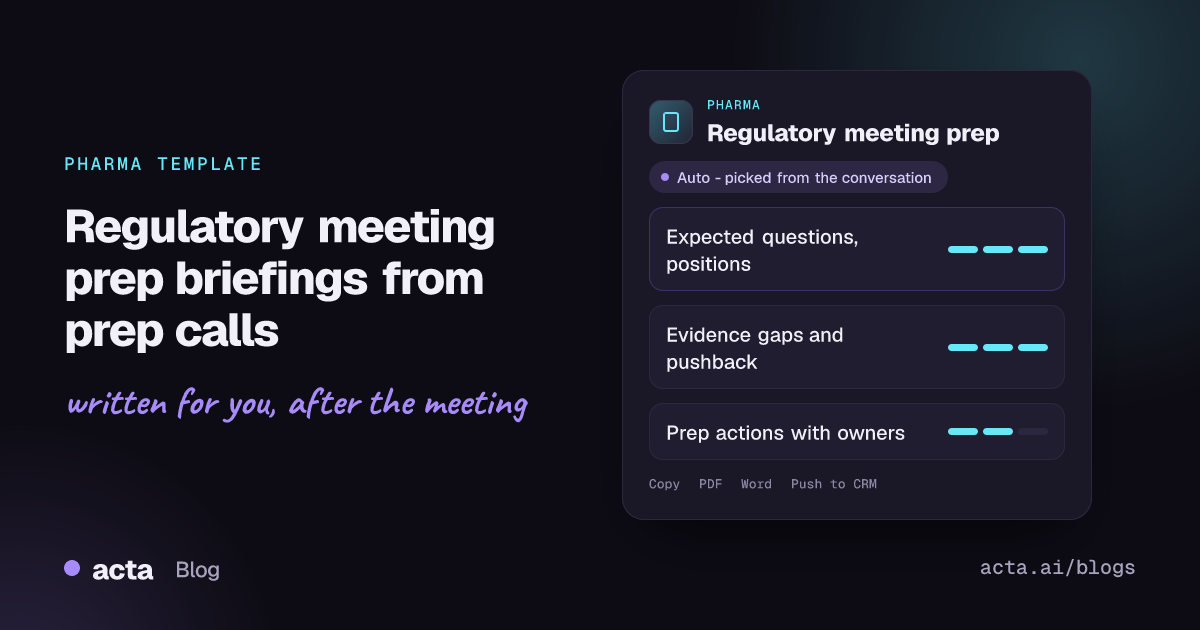
Quick answer: A regulatory meeting prep briefing is an internal document that gets a team ready for a meeting with a health authority such as FDA or EMA. It lists the questions the team expects, the agreed position and supporting evidence for each, the evidence gaps and likely pushback, and the preparation actions with owners and dates. Acta writes it from the recordings of your prep meetings.
A formal meeting with a health authority is short and high stakes. A drug development team may get an hour, sometimes less, to discuss a phase 3 design, a dose rationale or a filing strategy. Weeks of internal preparation go into that hour: question-by-question rehearsals, debates about which data to lead with, and mock sessions with former agency reviewers.
Those prep meetings produce a lot of decisions that are easy to lose. Who agreed the fallback position on the comparator? Which subgroup analysis was promised for the briefing book? Acta's Regulatory meeting prep template captures that work as a single briefing the whole team can rehearse from.
What is a regulatory meeting prep briefing?
Sponsors meet regulators at key points in development: before an IND, at the end of phase 2, before a marketing application, or when a program needs advice on a specific issue. In the US these are formal meetings described in FDA's guidance on formal meetings between FDA and sponsors or applicants of PDUFA products, which sets out meeting types, formats and how requests and meeting packages are handled. In the EU, developers can request scientific advice and protocol assistance from EMA on study design and methods before they apply.
In both cases the sponsor submits questions in advance, and the meeting itself is spent on the points where the agency's view differs from the sponsor's. The prep briefing is the internal companion to the formal meeting package. It is not submitted to anyone. It records how the team plans to answer each likely question, what evidence backs that answer, where the data are thin, and who is doing what before the meeting. Regulatory affairs usually owns it, with input from clinical, statistics, CMC and safety.
What does Acta's Regulatory meeting prep report include?
The report has three sections:
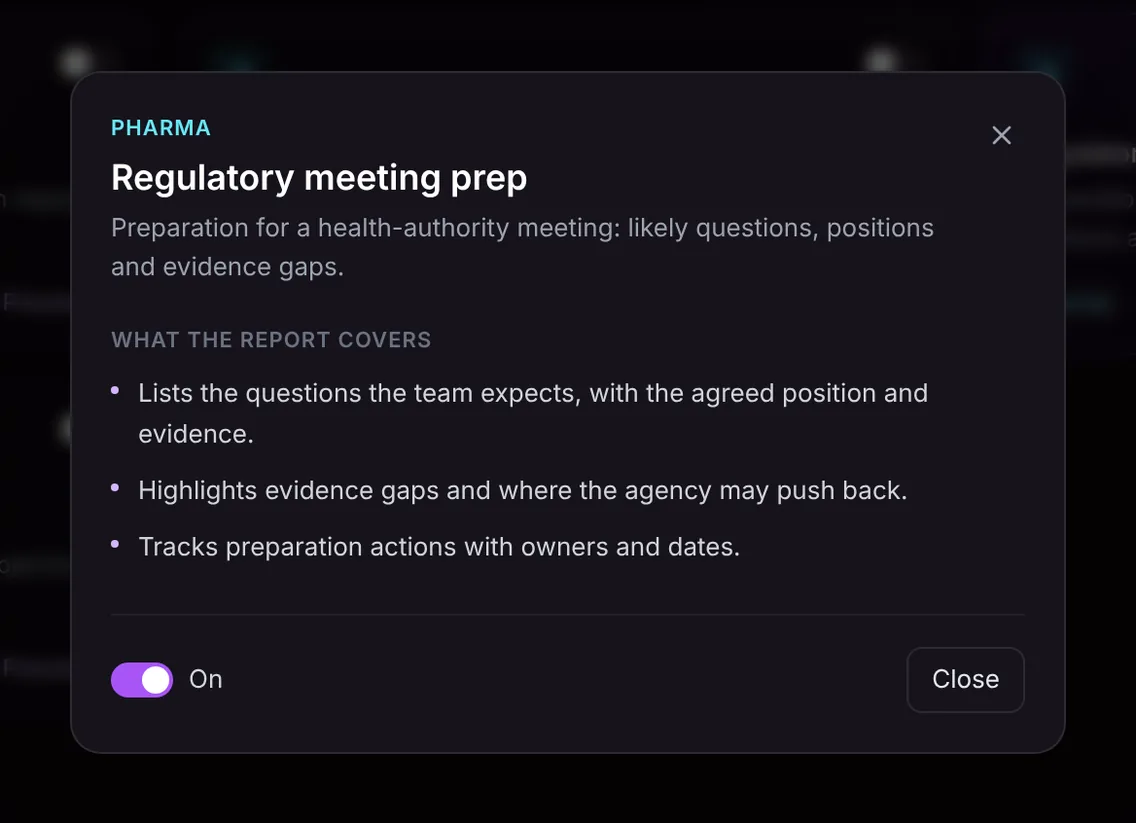
- Expected questions, positions and evidence. Each question the team expects the agency to raise, with the position the team agreed and the evidence it will point to.
- Evidence gaps and pushback. Where the data are weak or missing, and where the team thinks the agency may push back, so the team can prepare a fallback or decide what to concede.
- Preparation actions. Tasks agreed in the prep meeting, such as extra analyses, slide changes or a mock session, each with an owner and a date.
Here is the template in Acta's Templates page, with the preview of what the report covers:
And an illustrative example of a finished report:
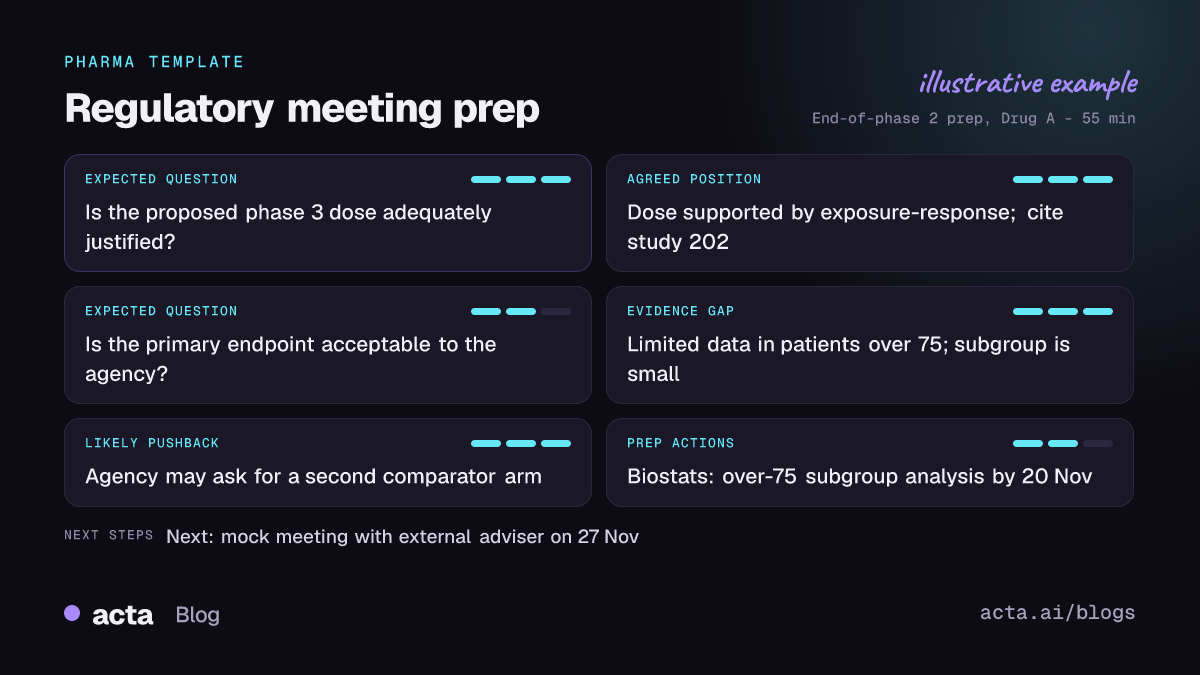
The report only contains what was said in the prep meeting. It does not add regulatory interpretation, predict the agency's answer or fill in evidence nobody mentioned. If the team did not settle a position on a question, the briefing shows that the question is still open.
Who is the regulatory prep briefing for?
- Regulatory affairs leads who coordinate the meeting request, the package and the rehearsal plan.
- Clinical and biostatistics leads who own the answers on design, endpoints and analyses.
- Program and project managers who track the prep actions against the meeting date.
- Senior leaders who will speak in the meeting and need a one-page view of positions and risks.
It helps in moments like these: a team holds four prep sessions over three weeks and needs one consolidated view of positions; a statistician joins late and must see which analyses were promised; or the team wants to compare the agency's actual questions with the ones it predicted. With OneChat you can also ask questions across all your prep meetings, such as "what did we agree on the comparator arm?", and get answers with sources.
How does Acta pick this template automatically?
After each meeting, Acta reads the conversation and picks a fitting template even if you have not turned it on. For regulatory prep, the signals are a team discussing an upcoming health authority meeting: phrases like "the agency will ask", draft questions for the briefing package, agreed responses, references to supporting studies, worries about weak data, and owners assigned to analyses before the meeting date.
When Acta picks it on its own, the report is labelled "Auto" and Acta says why, for instance that the meeting rehearsed expected agency questions and assigned prep actions. Click "Turn on for future meetings" to keep it for the rest of the program.
If the template is turned on, it first checks that the meeting is regulatory preparation. A routine project status meeting or a vendor call is listed under "Not relevant" with the reason, rather than producing a forced briefing.

How do you use the Regulatory meeting prep template?
- Record your prep meetings. Acta records Zoom, Google Meet and Microsoft Teams through a meeting bot, or without one through the bot-free desktop app, the Chrome extension or the mobile apps. You can also upload a recording of a mock session.
- Turn the template on. Go to Templates, open the Pharma group, preview Regulatory meeting prep and switch it on, or let Acta pick it.
- Open the Templates tab. The briefing appears in the meeting's Templates tab beside the summary, transcript, decisions and action items.
- Share it with the team. Copy it, or download it as PDF, Word or Markdown to drop into your prep folder or rehearsal deck.

Tips for a stronger prep briefing
- Read each question aloud before debating it. The briefing can then list the exact wording the team expects.
- Close each question with the agreed position. "So our answer is..." makes the position explicit.
- Name the evidence. Mention the study, table or analysis you will cite, so it appears beside the position.
- Assign every gap. When someone says the data are thin, agree who will address it and by when.
Related pharma templates: MSL field insights from HCP meetings and clinical trial site meeting notes. See also Acta for pharma teams.
Frequently asked questions
What goes into an FDA meeting prep document?
Typically the questions you expect the agency to raise, your position and evidence for each, known data gaps and likely pushback, fallback positions, and a list of preparation tasks with owners and dates.
Is the briefing the same as the meeting package sent to the agency?
No. The briefing is an internal working document built from your prep meetings. The formal meeting package is a separate submission prepared by your regulatory team.
Does Acta give regulatory advice?
No. The report only contains what your team said in the meeting. It organises the team's own positions, gaps and actions; it does not interpret regulations or predict the agency's view.
Can I use it for EMA scientific advice as well as FDA meetings?
Yes. The template works for preparation for any health authority meeting where the team rehearses expected questions and positions.
Run your next prep session with Acta recording: start a free 15-day trial.


