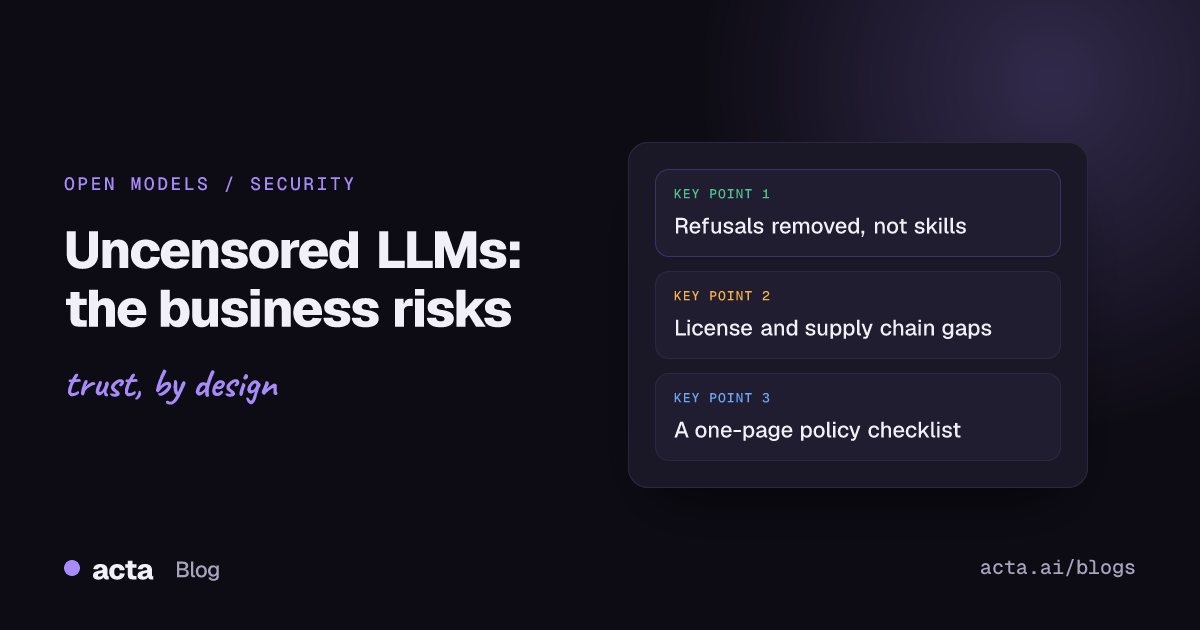
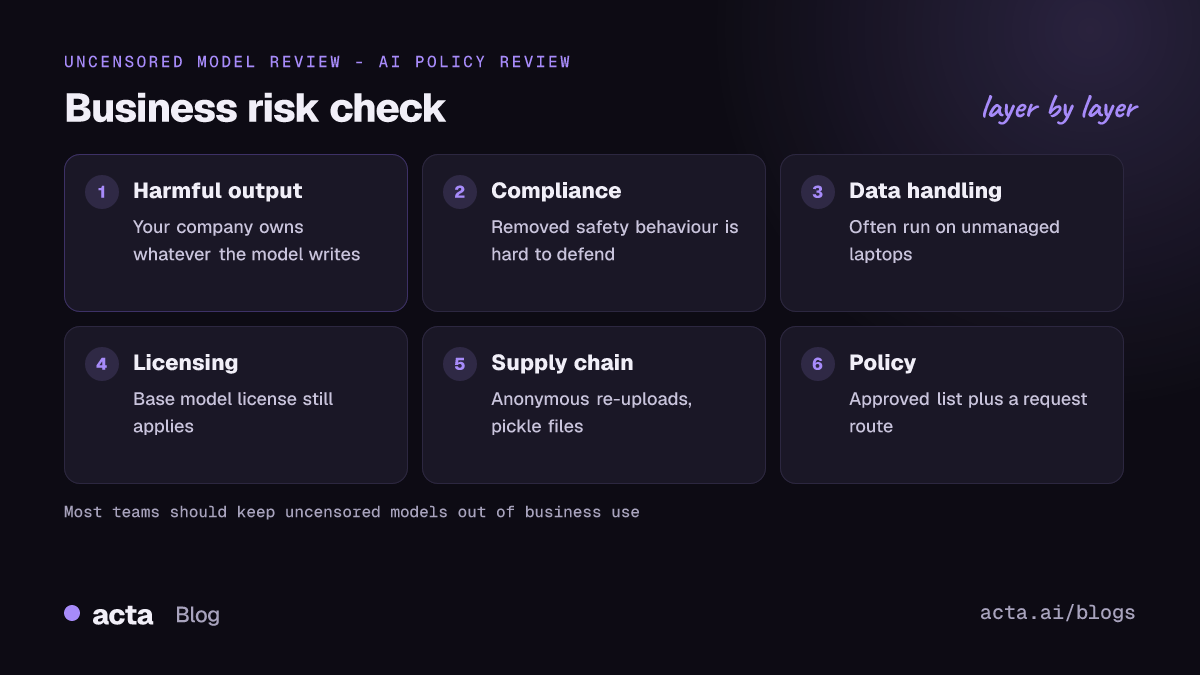
Quick answer: An uncensored LLM is an open-weight model whose refusal behaviour has been weakened or removed, either by fine-tuning or by a weight edit called abliteration. People use them to stop false refusals and for research. For a business, the risks are harmful output with your name on it, compliance gaps, unclear licenses and untrusted files, so most teams should keep them out of production.
If you browse Hugging Face for more than ten minutes you'll see them: model names ending in "uncensored", "abliterated" or something edgier, often with big download counts. Someone on your team will eventually ask whether they can use one. This post explains what these models actually are, why people want them, and what I'd put in a company policy before anyone pulls one onto a work laptop.
What is an uncensored LLM, exactly?
Most chat models ship with a layer of safety training. Ask for something the developer decided it shouldn't help with, and it declines. An uncensored LLM is a version of an open model where that refusal behaviour has been reduced or taken out. The base knowledge is mostly the same; what changes is how willing it is to answer.
There are two common routes:
- Fine-tuning. Someone retrains the model on a dataset with the refusals filtered out, so it learns to just answer.
- Abliteration. No retraining at all. You find the internal "refusal direction" and subtract it from the weights. The result is usually called an abliterated model.
Neither route adds new skills. An uncensored 8B model isn't smarter than the 8B model it came from. It's the same model with fewer brakes, and editing weights can shift its behaviour in ways nobody tested.
How does abliteration work?
The idea comes from a 2024 research paper, Refusal in Language Models Is Mediated by a Single Direction by Arditi and co-authors. They looked at 13 open-source chat models, up to 72B parameters, and found that refusing harmful requests was largely controlled by one direction inside the model's internal activations. Remove that direction and the model stops refusing. Add it and the model starts refusing harmless requests.
Maxime Labonne then wrote a widely shared walkthrough on the Hugging Face blog, Uncensor any LLM with abliteration, which turned the finding into a recipe anyone with a GPU can follow. Roughly:
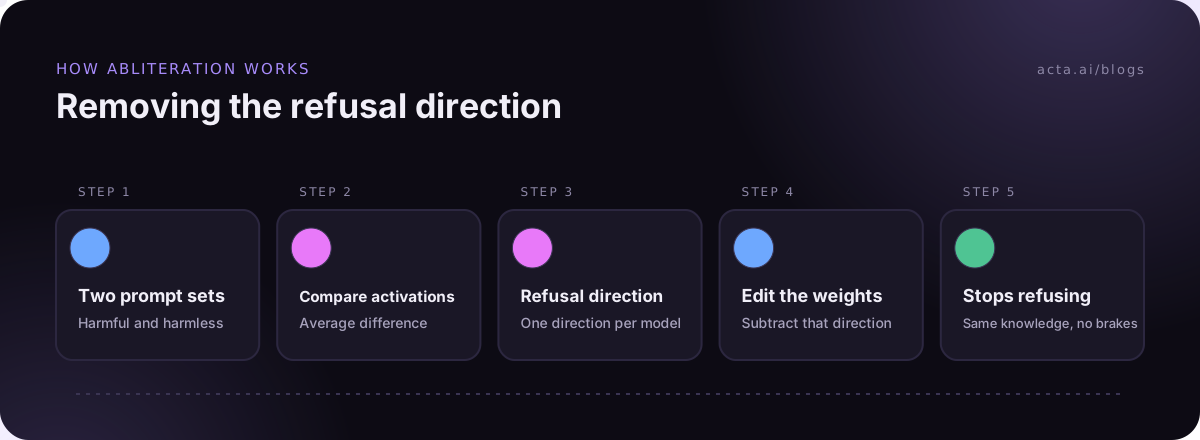
- Run a set of harmful prompts and a set of harmless prompts through the model.
- Record the internal activations for both and compare them.
- The average difference points along the refusal direction.
- Edit the weights so the model can no longer write along that direction.
- Test: the model now answers prompts it used to decline.
It isn't perfectly clean. Later work argues refusal is messier than a single direction, and community tool authors say plainly that abliteration doesn't guarantee every refusal is gone. For a business that's a detail. The point is that it's cheap, it's automated, and anyone can publish the result.
Why do people download uncensored models?
It's easy to assume bad intent, and that's mostly wrong. The common reasons are pretty mundane:
- False refusals. Safety-tuned models sometimes decline harmless things: a nurse asking about overdose thresholds, a security engineer asking how a known exploit works, a novelist writing a crime scene.
- Research. Red teams and safety researchers want to see what a model does without its guard rails.
- Fiction and role-play. Hobbyists want characters who don't break into a lecture every third line.
- Curiosity. Something is labelled "uncensored", so people try it.
Some of those are legitimate needs. But notice that none of them looks like "summarise this customer call" or "draft a reply to procurement". Ordinary work rarely hits a refusal, and when it does, a better prompt or a different mainstream model usually fixes it.
What are the real risks of an uncensored LLM for a business?
Here's how I'd break it down for a team that wants a straight answer rather than a scare story.
Harmful or embarrassing output
Whatever the model writes, your company produced it. A support bot that will happily explain how to bypass your own product's safety features, or a drafting assistant that writes something abusive when a colleague tests it for a laugh, becomes a screenshot. Safety training is imperfect, but it's still the main thing between a stray prompt and that screenshot.
Compliance and policy gaps
Many regulated teams have to show they put reasonable controls on automated systems. "We deliberately removed the vendor's safety behaviour" is a hard sentence to defend to an auditor, a customer's security questionnaire, or a works council. Even outside regulated industries, your AI acceptable use policy probably says something about harmful content. Running a model built to ignore that is a contradiction you'll have to explain.
Data handling
This one is less about the model and more about the setup. Uncensored models are usually run locally through community tools, on personal machines, outside IT's view. That's where client data ends up in a chat history on an unmanaged laptop. The model's attitude matters less than where the prompts and outputs live afterwards.
Licensing
An abliterated model is a derivative of someone else's model. The original license still applies, including any acceptable use terms the original developer attached. Some uploads drop the license field or set it to "other" with no text. If you can't trace a model back to its base and its terms, you can't tell if commercial use is even allowed.
Model supply chain
Anyone can upload weights. Hugging Face's own pickle scanning documentation explains that pickle, the default format for PyTorch weights, can run arbitrary code when you load it. The Hub scans uploads for malware and suspicious imports, and it recommends safetensors, a format that stores only tensors. Scanning helps; it doesn't make an anonymous re-upload trustworthy. Model supply chain risk is real for every open model, and the uncensored corner of the Hub is full of small accounts re-uploading other people's work.
Is an uncensored model ever the right call at work?
Occasionally, yes. A security team testing its own defences, or a trust-and-safety group studying what attackers can generate, may have a real reason. The difference is that they do it on purpose, in an isolated environment, with no customer data, and with someone accountable for the output.
What I'd push back on is the casual case: "the normal model refused once, so I grabbed the uncensored one". That trades a minor annoyance for a set of risks nobody signed off on. If a mainstream model keeps refusing a legitimate task, write down the prompt and the refusal and send it to whoever owns your AI tooling. That's useful information. Quietly switching models isn't.
A practical AI acceptable use policy checklist for open models
You don't need a 30-page document. A one-page AI acceptable use policy that covers open models should answer these:
- Approved list. Which models and versions are allowed, for which tasks. Everything else needs a request.
- No uncensored or abliterated models for business use, unless it's a named research exception with an owner and an isolated machine.
- Provenance. Use the original publisher's repository or a known quantizer. Check the base model and license on the model card before download. Our guide to reading a Hugging Face model card shows where to look.
- File format. Prefer safetensors or GGUF from trusted sources. Don't load pickle files from unknown accounts.
- Data rules. No customer, patient or employee data in unapproved tools. Say where chat histories may be stored.
- Output review. Anything customer-facing gets a human check before it ships.
- A route for refusals. Give people a place to report false refusals so they don't go looking for workarounds.
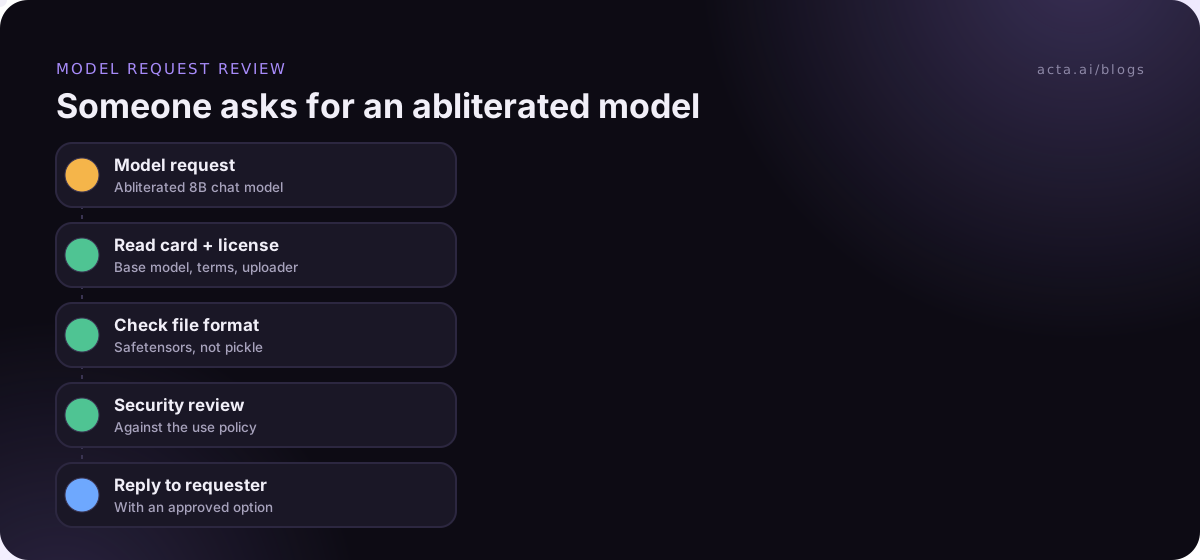
The request process can be light. Here's roughly what one review looks like when someone asks for an abliterated model:
For the supply chain side in more depth, see our post on AI supply chain security for models, datasets and connectors. And if your worry is mostly about sensitive text leaking out of prompts, AI data leakage covers that. One thing a stricter model won't fix on its own is prompt injection; a system prompt is not a security boundary, whichever model you run.
What about meeting notes and summaries?
A lot of "can I use this model?" questions start with meetings. Someone wants to paste a transcript into a local chat app and get a summary. Honestly, summarising a 45-minute project sync doesn't need an uncensored LLM. It needs a model that sticks to what was said, names the right speakers and doesn't invent decisions. Removing refusals does nothing for any of that.
The harder problems are around the model: getting a clean transcript with speaker names, keeping access tight, and deciding where meeting data lives. If you'd rather not run and police models yourself, a finished tool can be the simpler choice. Acta joins Zoom, Google Meet and Microsoft Teams with a bot, or captures audio through a bot-free desktop app or Chrome extension, and gives you a transcript with speaker names, a summary, decisions and action items with owners. Acta does not use customer data to train AI models, which we explain in why we don't train on customer data, and the security page covers how we handle data. If you capture calls with any tool, it's worth reading up on consent and what to tell participants when you record meetings.
If you still want to experiment locally with a mainstream model, our guide to running a local LLM on your laptop is a good, safe place to start.
Frequently asked questions
Is it illegal to download an uncensored LLM?
Generally, downloading one isn't illegal in itself. What you do with it can be, and the original model's license may restrict uses. For a company the bigger question is policy: whether running it fits your own rules and your customers' expectations.
What does "abliterated" mean on Hugging Face?
An abliterated model has had its refusal direction removed from the weights, using the method popularised by the Hugging Face blog post on abliteration. It isn't retrained, so it keeps the base model's knowledge but declines far less often.
Are uncensored models more accurate?
No. Abliteration and refusal-free fine-tuning change willingness, not knowledge. Editing weights can also change behaviour you didn't intend to touch, so test any variant against the original on your own tasks before trusting it.
Is safetensors enough to make a model file safe?
Safetensors removes the code-execution risk that comes with pickle files, which is a big improvement. It says nothing about who trained the weights or what the model will output, so you still need provenance and output checks.
How should we handle staff who already use one?
Ask what problem they were solving. Usually it's a false refusal or a hobby project. Move the work to an approved model, delete any company data from the local setup, and add their use case to your request process so the next person has a proper route.
If you want meeting summaries and action items without picking, vetting or hosting a model, try Acta with a 15-day free trial.