Quick answer: It depends on where you and the other people are. US federal law and most US states let you record a conversation you take part in (one-party consent), but about 11 states require everyone's consent. Canada allows a participant to record. The UK, EU, India and Australia add privacy rules. Recording other people's private conversations without anyone's consent is illegal almost everywhere.
This article is general information, not legal advice. Laws change and depend on the facts, so check the current law where you and the other people are, or ask a lawyer, before you rely on a recording.
People ask whether it is illegal to record a conversation for very different reasons: keeping a record of a difficult phone call, documenting a dispute with a landlord or employer, recording an interview, or letting a note taker capture a work meeting. The answer turns on three things: whether you are part of the conversation, who has agreed to the recording, and which laws apply where each person is.
This guide covers the general rules. If your question is about recording work meetings with an AI note taker, read our deeper guide, Is it legal to record meetings with AI? Consent, privacy and what to tell participants.
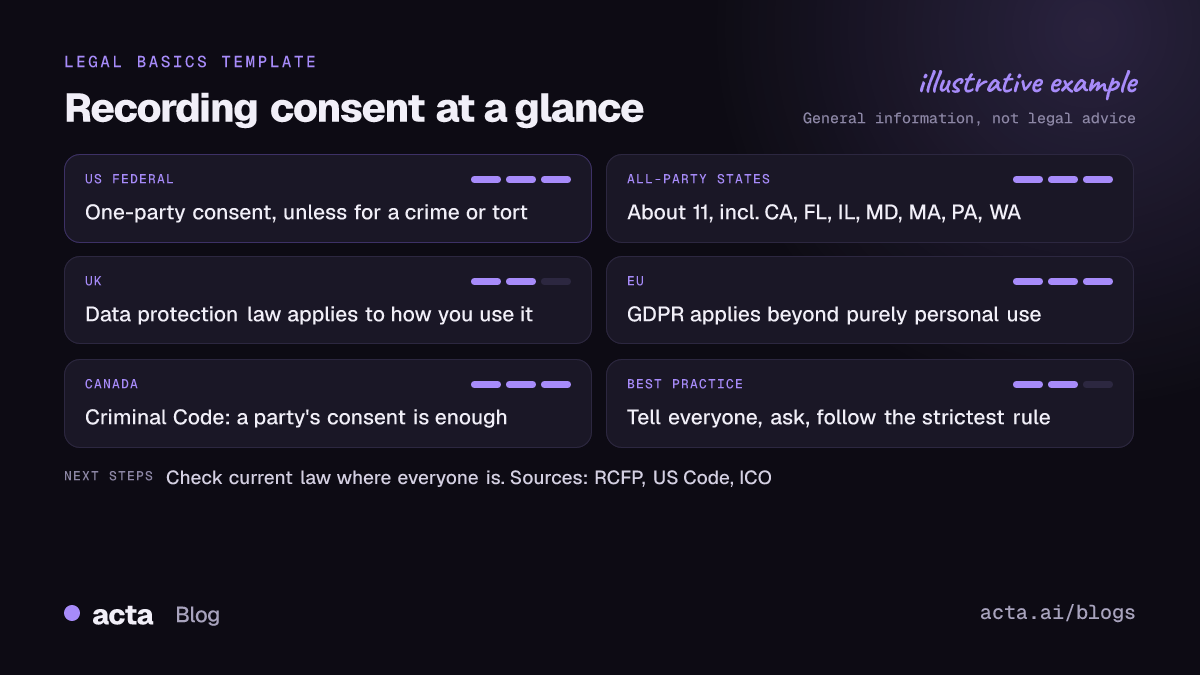
When is it illegal to record a conversation?
Across the countries covered below, a few patterns hold:
- Recording a conversation you are not part of (for example, leaving a phone on a table to capture what others say after you leave, or tapping someone's line) is the clearest case. Without the consent of at least one person in the conversation, it is a crime in the US under federal law and in Canada under the Criminal Code.
- Recording a conversation you take part in is legal in many places without telling the others, but not everywhere. Some US states, and some other countries, require everyone's consent.
- Using or sharing the recording can be a separate problem. Privacy and data protection laws can apply even when making the recording itself was allowed.
So the honest short answer to "is it illegal to record a conversation?" is: sometimes. The rest of this guide explains where the lines usually fall.
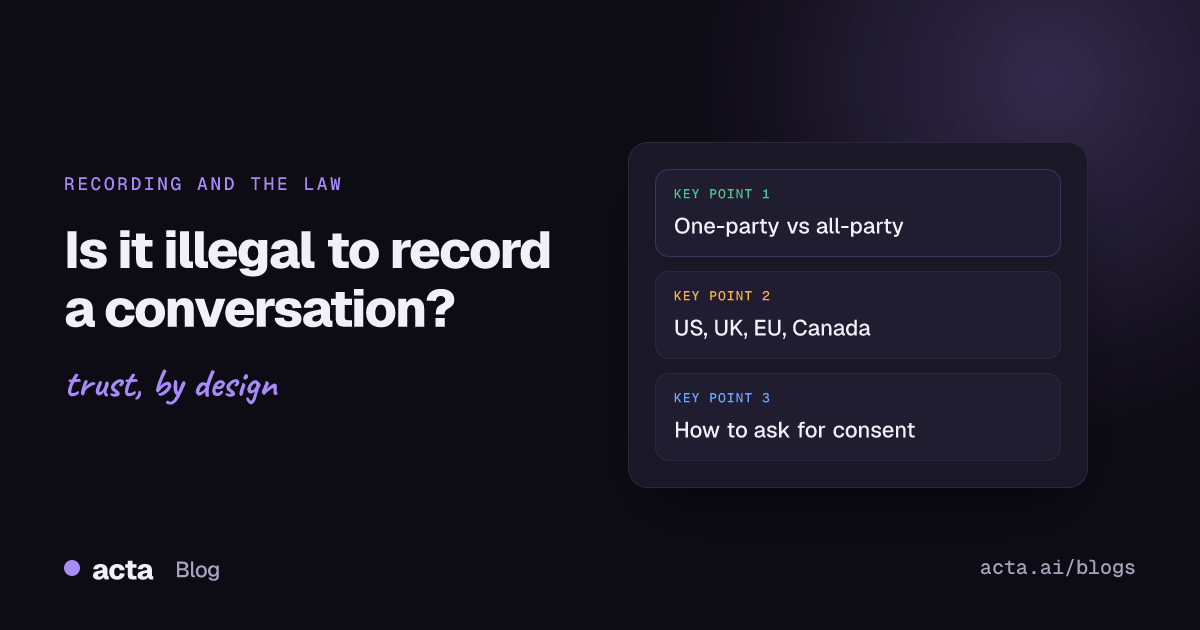
One-party consent vs all-party consent: what's the difference?
These are the two models you will see in recording consent laws, especially in the US.
- One-party consent means a recording is lawful if at least one person in the conversation agrees to it. If you are in the conversation, your own consent is enough.
- All-party consent (sometimes called two-party consent) means everyone in the conversation must agree before it is recorded.
In practice, "consent" does not always mean a signed form. A clear announcement at the start ("I'm recording this call so I have an accurate record, is that OK?") followed by people staying on the call is how many people and businesses handle it. Whether that counts as consent in your situation depends on the specific law, which is why getting a clear "yes" is the safer habit.
Is it legal to record a phone call in the US?
At the federal level, the Wiretap Act, 18 U.S.C. 2511, generally prohibits intercepting wire, oral or electronic communications, but it includes a one-party consent exception: a person who is a party to the communication, or who has the consent of one party, may record it, unless the recording is made to commit a crime or a tort. Federal law sets a floor, not a ceiling, so a stricter state law can still apply.
All-party consent states
According to the Reporters Committee for Freedom of the Press recording guide, about 11 states primarily require the consent of all parties to record: California, Delaware, Florida, Illinois, Maryland, Massachusetts, Michigan (at least for recordings made by a third party who is not in the conversation), Montana, New Hampshire, Pennsylvania and Washington.
State rules have details and exceptions. For example, the Reporters Committee notes that California's law does not cover conversations in public places or where people could reasonably expect to be overheard or recorded. Other guides also differ on some states: Justia's 50-state survey, for instance, says Connecticut uses one-party consent for criminal purposes but imposes civil liability for recording phone calls without all-party consent, and older Reporters Committee material notes that Nevada's courts have read its statute as requiring all-party consent for phone calls. Because sources disagree at the edges, check the current law for your state before relying on a list.
What if people are in different states?
Calls and video meetings often cross state lines. The Reporters Committee advises assuming the stricter law applies: if you are in a one-party state and the other person is in an all-party state such as California, get everyone's consent. That is also the simplest rule for anyone recording calls with customers or colleagues spread across the country.
Is it illegal to record a conversation in the UK?
The UK does not use the US "one-party vs all-party" labels. Recording a conversation you are part of, for your own records, is generally treated differently from intercepting other people's communications. The bigger questions in the UK tend to be about what you do with the recording and whether data protection law applies.
For organisations, the Information Commissioner's Office (ICO) is the regulator. Its guidance on data protection and monitoring workers, which covers practices such as recording calls, says monitoring must be consistent with data protection law and balanced against workers' rights. Points from that guidance:
- Be clear about why you are monitoring, and don't monitor workers "just in case".
- Workers should be told about monitoring, and in most cases before it takes place.
- Covert monitoring should be rare: authorised by senior management, targeted at a specific investigation and time-limited, with a data protection impact assessment (DPIA).
- Keep recordings only as long as you need them for the stated purpose.
- Don't assume a tool you buy complies with data protection law; check it.
The ICO notes that this guidance is under review following the Data (Use and Access) Act, so check its site for the current version. The ICO has also taken action over undisclosed call recording: in 2023 it reprimanded two police forces for recording more than 200,000 calls without people's knowledge.
What about the EU and GDPR?
In the EU, a recording of an identifiable person's voice is personal data, so the General Data Protection Regulation (GDPR) is the starting point for businesses. GDPR has a "household exemption" for purely personal or household activity. The Irish Data Protection Commission explains that whether the household exemption applies depends on the facts of each case, and that it does not cover personal data used in connection with a professional or commercial activity or made publicly available.
In other words, a private voice memo of a family conversation is treated very differently from a company recording client calls. A business recording meetings needs a lawful basis, has to tell people, and must handle the recording under GDPR. National laws in each EU country can add their own rules on recording, so check the country involved. Our GDPR checklist for AI note takers covers the business side in more detail.
Canada, Australia and India: what do the rules say?
Canada
Under section 184 of Canada's Criminal Code, knowingly intercepting a private communication is an offence that can carry up to five years in prison. The section does not apply to a person who has the express or implied consent of the person who made the communication or the person it was meant for. In practice, this is commonly read as a one-party rule: a participant can record a conversation they take part in. Recording other people's private conversations without any participant's consent is not covered by that exception. Privacy laws can still apply to how a business uses recordings.
Australia
Australia has no single national rule for recording private conversations. Each state and territory has its own surveillance devices law, and law-firm guides describe real differences between them: several say New South Wales, the ACT, South Australia and Western Australia generally require the consent of all parties, with exceptions such as recording to protect a person's lawful interests, while Victoria is described as more lenient in some cases, and Queensland has its own rules. These guides don't agree on every detail, so check the law of the state or territory involved before recording.
India
India has no single statute that answers the question directly, and sources disagree on how strict the rule is. Courts have treated secret recordings as a privacy issue: the Chhattisgarh High Court held in 2023 that recording a person's mobile phone conversation without their knowledge violated the right to privacy under Article 21 of the Constitution, and the Delhi High Court has expressed the preliminary view that recording calls without consent is a breach of privacy. If you are in India, get consent and take advice before relying on a secret recording.
Does it matter if it's a phone call, in person or a video call?
Usually the same principles apply, but the details can change:
- Phone calls are the classic case for wiretap laws. In all-party consent states, recording a call without everyone's agreement is the core thing those laws target. For the practical side, see our guides to iPhone call recording and recording phone calls on Android.
- In-person conversations are often covered too. US laws commonly protect "oral communications" where people expect privacy, and California's rule, for example, excludes conversations in public places where people could expect to be overheard.
- Video calls are electronic communications, and they often involve people in several states or countries at once. Built-in recording notices in meeting apps help people know a recording is happening, but they don't decide which law applies. The safest approach is to say you're recording and ask everyone.
Our guide on how to record a conversation covers the practical options for each situation.
Can I secretly record a conversation at work?
Secret recording at work is where legal and practical risks pile up. Even in a one-party consent place, a hidden recording of a meeting with your manager or a colleague can break your employer's policies and damage trust, and in all-party consent states it may be a crime. For employers, the ICO's guidance treats covert monitoring as an exception that needs senior sign-off, a specific investigation and an impact assessment.
If you need a record of a work conversation, these options usually carry less risk:
- Ask openly: "Do you mind if I record this so I have accurate notes?"
- Take written notes and send a short summary email afterwards, asking the other person to confirm or correct it.
- Follow your company's policy on recording meetings and on which tools are approved.
For recording work meetings with AI note takers, including what to tell participants, see our full guide to AI meeting recording and consent.
How do I get consent to record properly?
Whatever the law where you are, clear consent avoids most problems. A simple routine:
- Tell people before you start. Put it in the meeting invite and say it at the beginning: who is recording, why, and who will see the recording or notes.
- Ask, and get a clear answer. A spoken "yes" captured at the start of the recording is a useful record.
- Offer an alternative. If someone says no, stop recording or let them leave the recorded part.
- Tell late joiners. Repeat the notice when someone joins after the start.
- Keep it only as long as needed and limit who can access it.
- Follow the strictest rule when people are in different states or countries.
If you use a meeting note taker, the way it records affects how people know about it. With Acta, the meeting bot joins Zoom, Google Meet or Microsoft Teams from your calendar and appears in the participant list. Acta's bot-free note taker (a desktop app and a Chrome extension) records the computer's sound and your mic without a bot joining, so you need to tell people yourself. Either way, you are still responsible for consent. Acta does not record phone calls; if you record a call yourself where it's legal, you can upload the audio to Acta for a transcript and notes. People in your workspace only see meetings they have access to, and Acta does not use customer data to train AI models. More on that on our security page.
Frequently asked questions
Is it illegal to record a conversation without telling the other person?
It depends on where you and they are. Under US federal law and in most US states you can record a conversation you're part of, but about 11 states require everyone's consent, and other countries add privacy rules. This is general information, not legal advice.
Which US states require all-party consent?
The Reporters Committee for Freedom of the Press lists California, Delaware, Florida, Illinois, Maryland, Massachusetts, Michigan (for third-party recordings), Montana, New Hampshire, Pennsylvania and Washington. Other guides add nuances for states such as Connecticut and Nevada, so check the current law.
Can a secret recording be used as evidence?
Sometimes, but not always. An illegally made recording can expose you to criminal or civil liability, and courts in some countries have refused to admit secret recordings or treated them as privacy violations. Ask a lawyer before relying on one.
Is it legal to record a phone call if I'm on the call?
In one-party consent places, such as under US federal law and in Canada, generally yes. In all-party consent states, and where privacy laws apply, you need everyone's agreement or at least a clear notice. When people are in different places, follow the stricter rule.
Is this article legal advice?
No. It is general information based on the sources linked above. Laws change and depend on the facts, so for a specific situation speak to a lawyer where you are.
Recording meetings with everyone's agreement? Try Acta free for 15 days to get transcripts, summaries and action items from them.