Repair approvals live in conversations, not in the system
A residential management team runs on a few regular meetings. The weekly maintenance meeting, where property managers and the maintenance coordinator go through open jobs, contractor quotes and anything awaiting landlord approval. Quarterly portfolio reviews with larger landlords, usually on Teams or Zoom, covering rent arrears, voids, compliance certificates and planned works. Contractor coordination calls. And a steady stream of landlord phone calls, which is where half the real decisions get made.
Your management agreement probably sets a spend limit, say £250, below which you can instruct repairs without asking. Above it, you need the owner's say-so. That say-so rarely arrives as a signed form. It arrives as "yes, go ahead, but keep it under three grand" on a call while the landlord is driving, and then lives in one property manager's head until the invoice turns up.
Three things go wrong without a proper record. Approvals get acted on after they were withdrawn. Conditions attached to an approval ("only if the tenant can be home on a weekday") get lost. And "patch it for now" decisions on damp or heating leave the firm exposed when the tenant complains again. GOV.UK's How to rent a safe home guide says landlords have a legal obligation to keep the home in repair, fit for human habitation and free from serious hazards, and the GOV.UK page for landlords on making repairs sets out what that covers. A managing agent carrying out the landlord's instructions wants a clear record of what those instructions were.
The boiler that was approved, then quietly un-approved
An illustrative case. Northgate Lettings & Management, a 34-person firm in Manchester, manages about 640 homes for 210 landlords. Claire is the director, Tom a senior property manager, Priya the maintenance coordinator, and Dev runs client accounts. One of Tom's landlords, Mr Whitfield, owns 14 flats across three buildings.
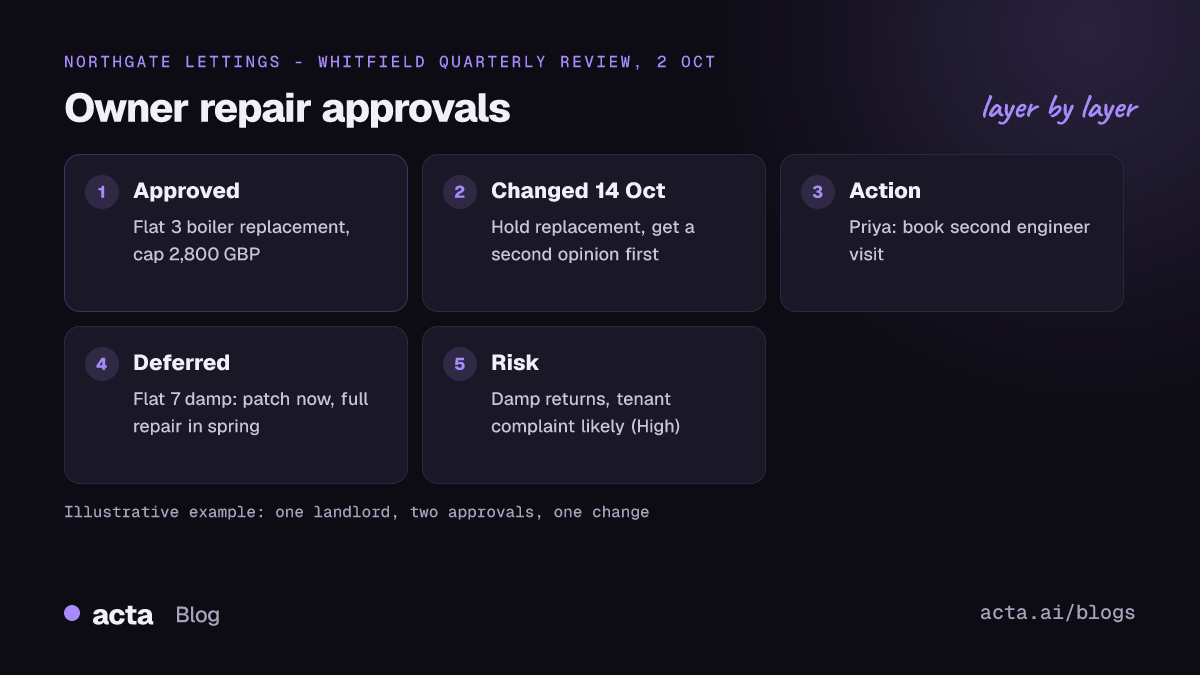
2 October, quarterly review (Teams). Tom raises two items. Flat 3 at 22 Albert Road has a boiler that failed its service and keeps losing pressure. Mr Whitfield says: "Replace it, but keep it under £2,800." Flat 7 has damp on the bedroom wall. He says: "Patch and repaint for now, we'll do the full job in spring." Tom tells Priya the next morning: boiler approved, damp patch approved.
14 October, phone call. Mr Whitfield rings Tom from a site visit elsewhere. His brother-in-law, a heating engineer, thinks the boiler might just need a new expansion vessel. "Hold off on the replacement, get a second opinion first." Tom says fine and makes a note on his phone.
16 October. Priya, working from the original approval, confirms the order with the contractor. The new boiler goes in on 21 October. Invoice: £2,650.
3 November. Mr Whitfield disputes the invoice. Separately, the tenant in Flat 7 emails photographs of black mould back on the repainted wall and mentions the council.
Nobody lied and nobody was lazy. A decision changed on a call, and the change had nowhere to live except Tom's phone notes. The damp patch was treated as a finished job when it was really a deferred risk.
A decision log makes property management owner meeting notes defensible
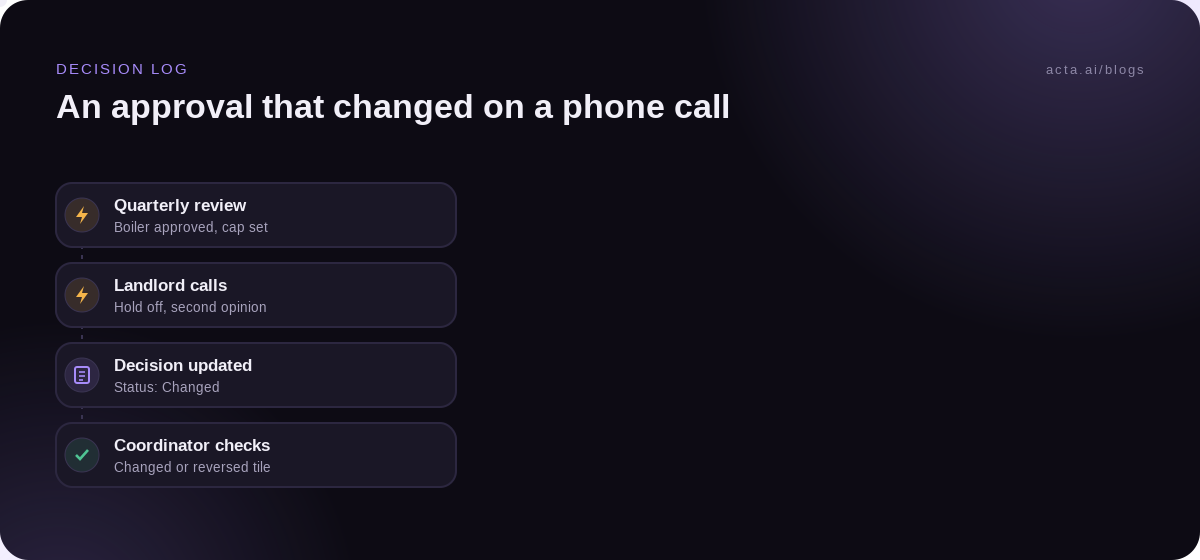
If Tom records both the quarterly review and the 14 October call, Acta builds his Decision log under My meetings > Outcomes > Decision log. It reads decisions out of each meeting, merges the ones that are really the same decision, and keeps a history of every meeting where it came up. Here is how the Albert Road boiler would look on 14 October:
| Field | What the decision card shows |
|---|
| Decision | Get a second opinion on Flat 3 boiler (22 Albert Road) before any replacement |
| Status | Changed. "Was: Replace Flat 3 boiler, up to £2,800 · changed 14 Oct" |
| Decided by / Owner | Mr Whitfield / Tom |
| History | 2 Oct quarterly review: first raised, "Replace it, but keep it under £2,800." 14 Oct call: updated, "Hold off on the replacement, get a second opinion first." |
| Actions | 0 of 1 done: "Book second engineer visit", owner Priya |
Each history entry has a play button that opens the recording at the moment the landlord said it. In a dispute, that is the difference between "I'm sure he said" and the landlord hearing his own voice.
The four tiles at the top do the triage. Changed or reversed is the one Priya should check before confirming any order with a contractor; on 16 October it would have shown the boiler. Need follow-through lists decisions whose linked actions are overdue or missing. You can Group by Topic, so all of Mr Whitfield's buildings sit together, or by Person to see what each property manager owns. Export CSV gives you a decision log template you can attach to a landlord statement, with columns for decision, status, decided by, owner, first and last discussed.
One honest limit: the Decision log belongs to the person who recorded the meetings, plus any meetings shared with them. Tom's log is Tom's. For Priya to see the change, Tom shares the call with "Everyone in" the workspace, and Priya reads it under Shared with me. For a team, that sharing rule matters more than any template. Our guide on how to track decisions made in meetings covers the habits around it.
An owner approval template records the limit and the conditions
Acta's built-in templates help with the surrounding work: Property walkthrough for inspections and check-ins, Vendor review for quarterly contractor performance, and Decisions & RACI for the weekly maintenance meeting. For landlord calls, write a custom template (a Pro feature) under Templates with "Create template":
Template name: Owner repair approvals
What should this report do? For calls and reviews with landlords: every repair discussed, the quote, the landlord's answer, any spending cap and conditions, and the effect on the tenant.
1. Repairs discussed (Table: Property and flat, Issue, Quote, Landlord's answer, Cap)
2. Conditions attached (Bullets: e.g. second quote, access days, contractor named)
3. Changes to earlier approvals (Paragraph)
4. Tenant impact (Bullets: heating, water, damp, safety, access)
5. Our next steps (Checklist: task, owner, due date)
Extra instructions: Quote the landlord's exact words for every approval. Write amounts as said.
Set it to "Only matching meetings" so it skips tenant viewings, and "Share with my team" so every property manager uses the same format. Test it on a past landlord call before switching it on.
Actions, damp risks and landlord questions in the same place
Action items
Under Outcomes > Action items, grouped by Person, Priya's list after 14 October would include: "Book second engineer visit for Flat 3 boiler, 22 Albert Road", owner Priya, "Due in 3 days", and from the review: "Patch and repaint Flat 7 bedroom wall", owner Priya, "Done". Auto follow-up can email her only her own due or overdue items each weekday morning.
Risk Registry
The Risk Registry tab is where "patch it for now" belongs. Row: Risk "Damp in Flat 7, 22 Albert Road only patched; full repair deferred to spring", Impact High, Owner Tom, Date 30 November, Mitigation Suggested (Acta's idea, not yet agreed) "Get a damp survey and agree the full repair date with the landlord", Status Open. When the tenant's mould photos come up in the next maintenance meeting, the row is tagged "Getting worse". A risk with no named person shows on the "High · no owner" card. A risk register example like this is what lets a director see deferred repairs across the whole portfolio, at least for the meetings shared with her.
OneChat
Before the next quarterly review, Tom asks OneChat: "What has Mr Whitfield approved or changed for 22 Albert Road since July, with amounts?" The answer: "Boiler replacement up to £2,800 approved 2 Oct, changed to second opinion 14 Oct; Flat 7 damp patch approved 2 Oct, full repair deferred to spring." Found in lists both recordings. The OneChat guide explains how to narrow the search to one landlord's meetings.
An agent confirms every approval in writing
The cheapest protection against approval disputes is a short email to the landlord the same day: "You approved X up to Y, on condition Z." Few teams send it consistently. Agent Builder (beta) can draft it every time a decision is made or changed, and the property manager approves it before it goes:
- In Agent Builder, click "New agent" and start from blank.
- Trigger: Event in a connected app, app Acta, event "decision made or changed". Add an "Only when" condition so it fires on decisions about repairs or approvals.
- Acta data: fetch the decision, its history quote and the meeting it came from.
- AI: "Write a three-line confirmation to the landlord: property, what was approved or changed, the cap and any conditions. Quote their words. No legal language."
- Human approval: goes to the property manager, with email Approve and Reject buttons turned on.
- Action: Gmail, send to the landlord.
- Action: Google Sheets, update the row for that property in your approvals sheet (status, amount, date).
- Run Test on the 14 October change and check the wording. Then Turn on.
If the property manager doesn't approve within 24 hours, nothing is sent. The three example agents in the help centre show a similar pattern for sales follow-ups.

A two-week rollout for a lettings and management team
In a 34-person firm, the people who record are the property managers, the maintenance coordinator and the director. Lettings negotiators can wait. Landlord reviews on Teams or Zoom are easiest with the desktop app, which records from your own computer with no bot and also handles WhatsApp or phone-app calls when you press Record. Tell landlords the call is recorded and why; the desktop app's "Copy notice" button helps on video calls, and our post on what to tell participants before recording has wording. Don't record tenants in their homes during inspections without telling them.
Week 1. Day 1: Claire sets up the workspace and invites Tom and Priya from Settings > Workspace. Days 2 to 4: Tom records every call with his three biggest landlords. Day 5: Tom and Priya read his Decision log together and agree that any decision tagged Changed gets checked before an order goes out.
Week 2. Day 6: build and test the Owner repair approvals template. Day 7: invite the other property managers; agree that every landlord call is shared with the workspace. Day 8: Priya records the weekly maintenance meeting. Day 9: turn on the confirmation agent for Tom only. Day 12: review a week of confirmations, fix the wording, then turn it on for everyone.
Mistakes we see: recording reviews but not the follow-up phone calls, where most changes happen; leaving meetings private, so the coordinator never sees the change; and closing "patch for now" jobs without a risk row. Acta's part is narrow: it records, writes the decisions with quotes and runs the confirmation agent. Your management agreement and your judgement still decide what needs approval. The Acta for property management companies page has a short summary.
Frequently asked questions
How should a letting agent record landlord approval for repairs?
Record the property, the work, the quote, the spending cap, any conditions and the landlord's own words, with the date. Then confirm it to the landlord in writing the same day. A recorded call plus a written confirmation is far easier to rely on than a phone note, especially when the landlord later changes the instruction.
What is the difference between a decision log and minutes?
Minutes summarise a meeting. A decision log tracks each decision across meetings: who made it, who owns it, its status and every time it was confirmed, changed or reversed. For repair approvals, the log answers "what is the current instruction for this flat?" without reading three months of minutes.
Can the maintenance coordinator see a property manager's decision log?
Not directly. Each person's Decision log is built from the meetings they recorded or that were shared with them. If property managers share landlord calls with everyone in the workspace, the coordinator can open those meetings, see the decisions and ask OneChat about them. Agree that sharing rule on day one.
Does recording a landlord call help in a dispute?
It gives you the landlord's exact words and the date, which usually settles honest misunderstandings quickly. Tell the landlord the call is recorded. Recording rules vary by country, so this is general information, not legal advice; check with your own adviser if a dispute could go formal.
What should we do with "patch it for now" repairs?
Treat them as open risks, not finished jobs. Give each one an owner, a date to revisit, and a note of the tenant impact. Damp, heating and safety items deserve the most attention, because landlords have repair duties that a temporary fix may not meet. Raise them again at the next landlord review.
Tighten your approval trail this month
Pick your three largest landlords and run their next calls through the full loop.
- Record the calls: reviews and phone calls, with the landlord told each time.
- Quote the cap: every approval gets an amount and the landlord's words.
- Check Changed first: no contractor order goes out without a look at the Changed or reversed tile.
- Confirm in writing: the agent drafts it, the property manager approves it.
- Log the deferrals: every "for now" repair becomes a Risk Registry row with an owner.
Start a 15-day trial and record your next landlord review with the desktop app, or the Chrome extension if you take it in the browser.