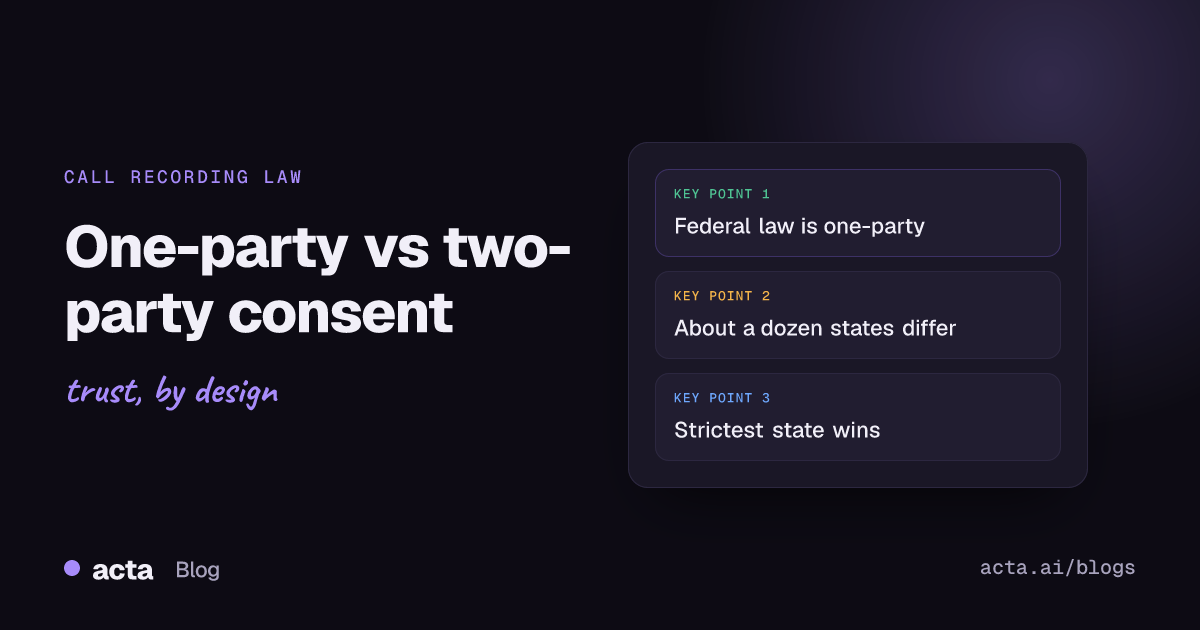
Quick answer: One-party consent means one person in the conversation, and that can be you, is enough to make a recording lawful. Two-party consent (better called all-party) means everyone on the call has to agree. US federal law is one-party, but about a dozen states want all parties. For call recording consent across state lines, the safe move is to follow the strictest state on the call.
Most people learn this distinction the hard way: a client in another state hears a beep, or doesn't hear one, and asks who said the call could be recorded. The terms sound simple. The trouble starts when a call has people in three states, or when a sales team records hundreds of calls a week and nobody quite knows where the other side is sitting.
This post covers the US rules and the practical questions about which rule applies. For the basics of recording conversations in person, see is it illegal to record a conversation? What follows is general information as of November 2026, not legal advice.
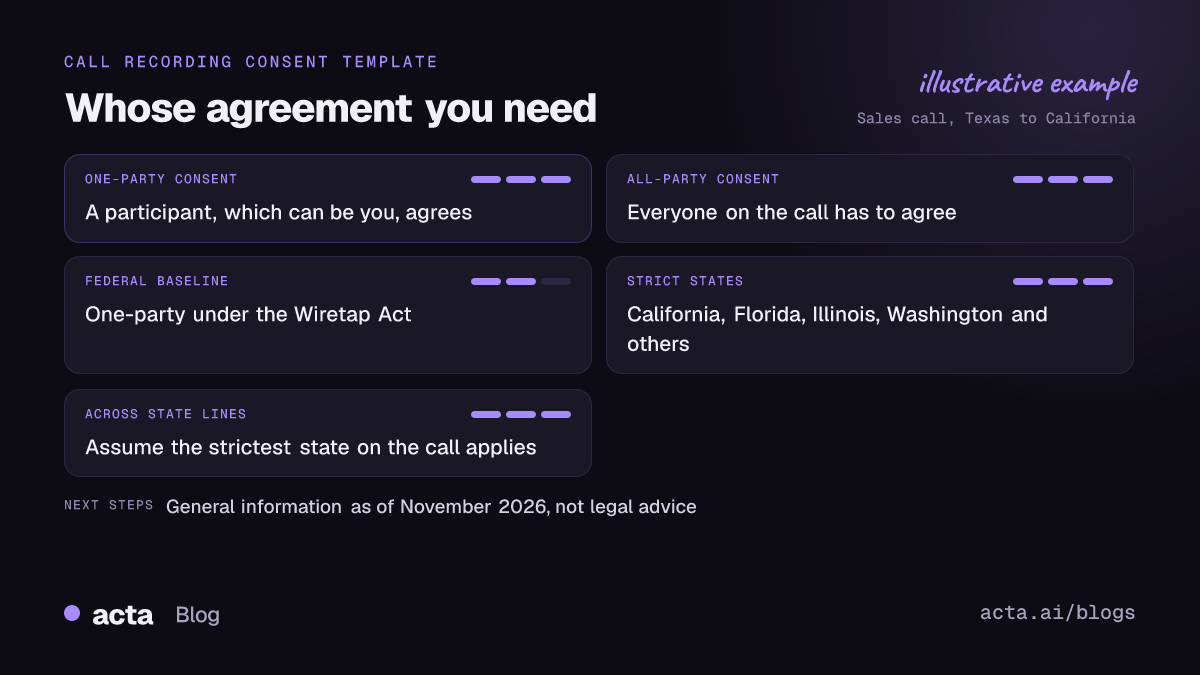
What is the difference between one-party and two-party consent?
It comes down to whose permission counts.
- One-party consent: if you're part of the conversation, your own agreement is enough. You don't have to tell anyone else, though you often should.
- Two-party or all-party consent: every person in the conversation has to agree. "Two-party" is an old name from when calls usually had two people on them. On a six-person video call, it means all six.
Neither rule lets you record a conversation you're not part of. Secretly recording other people's call, or leaving a phone running in a meeting room after you leave, is interception, and it's illegal under both rules.
What does federal law say about call recording consent?
The federal Wiretap Act, 18 U.S.C. § 2511, sets a one-party baseline. Someone who isn't acting for the government may record a call they're part of, or one where a participant has agreed in advance, unless the recording is made to commit a crime or a tort. Breaking the Act can mean criminal penalties and civil claims for damages.
Federal law is the floor, not the ceiling. States can be stricter, and plenty are.
Which are the two-party consent states?
There's no official list, and sources disagree at the edges. The two-party consent states named most often are:
- California
- Delaware (its wiretap law and privacy law point in different directions)
- Florida
- Illinois
- Maryland
- Massachusetts
- Montana
- Nevada
- New Hampshire
- Pennsylvania
- Washington
Connecticut, Michigan and Oregon are often listed as mixed. Their rules depend on whether it's a phone call or an in-person conversation, or whether you're facing a criminal charge or a civil claim. Kilpatrick's overview of wiretap laws in the United States is a useful starting point if you need the state-by-state detail. Everywhere else is generally one-party.
Penalties vary widely. Some states treat a violation as a felony, and several let the people recorded sue for damages. Don't assume the worst case is a warning letter.
What counts as a "confidential" call in California?
California is the state that comes up most, because so many clients and employees are there. Penal Code 632 bans recording a confidential communication without the consent of all parties. A conversation is confidential when the circumstances reasonably suggest that someone wants it kept among the people taking part. A pricing discussion with a client clearly qualifies. A public webinar with 400 attendees probably doesn't.
The useful detail is that 632 doesn't apply where everyone knows the call is being recorded. That's the logic behind the "this call may be recorded" message: once people have been told and they carry on, the recording isn't secret any more.
Which law applies when a call crosses state lines?
This is where most of the real risk is. Say your office is in Texas, a one-party state, and your client picks up in Los Angeles. You might think Texas rules apply because that's where the recorder is. California's Supreme Court disagreed.
In Kearney v. Salomon Smith Barney (2006), brokers in a Georgia office had recorded calls with clients in California without telling them. Georgia is one-party. The court held that California's all-party rule applied to those calls anyway, because the clients were in California, and stopped the firm from secretly recording them. The court also pointed out that a business that tells everyone at the start of the call that it's recording doesn't break the rule.
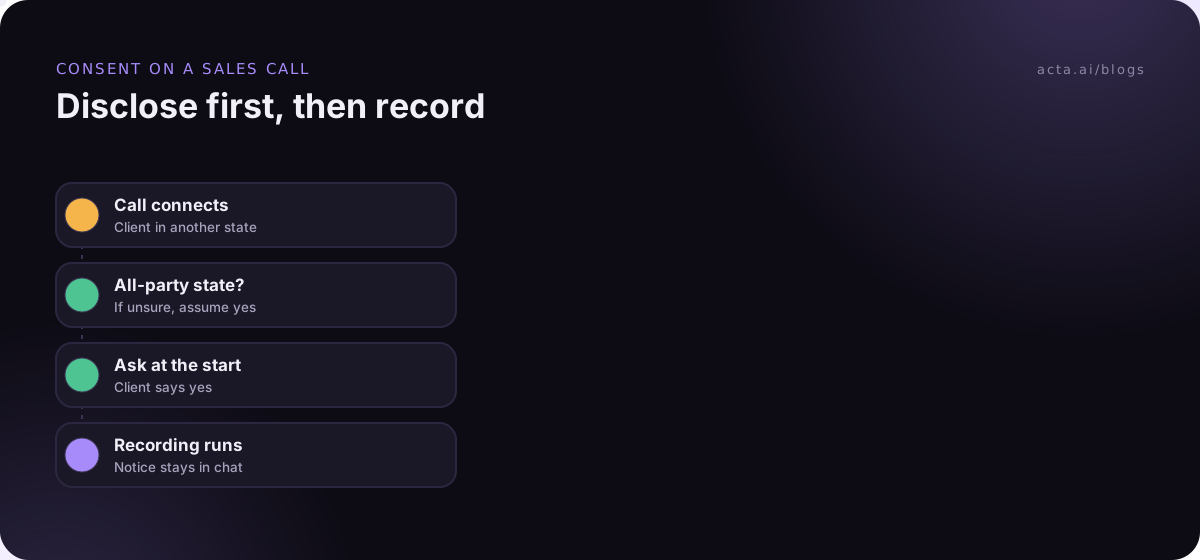
So for interstate calls, the working rule fits in one line: assume the strictest state involved applies. If you can't tell where everyone is, and with mobile phones and remote staff you usually can't, treat the call as all-party.
How does consent work on video meetings with many people?
The same principles apply to Zoom, Teams and Google Meet, just with more people and more places. A few points that come up a lot:
Platform recording banners help, but they aren't the whole answer
When you use a platform's built-in recording, the other attendees usually get a banner or a prompt. That's a decent disclosure. Recordings made from your own computer, whether by a desktop app or a browser extension, don't trigger those banners, so the notice has to come from you.
Late joiners missed the announcement
The person who joins eight minutes in never heard "we're recording". Repeat it, or put it in the chat where it stays visible. On a dial-in line, a recorded announcement at the start is common practice. Some state laws, Washington's for example, treat an announcement that's recorded as part of the call as consent.
Bots are visible, local recorders aren't
A notetaker bot in the participant list is a fairly clear signal. Recording bot-free with a desktop app such as Acta's is quieter by design, so say it out loud. Acta's desktop app has a Copy notice button that pastes a recording notice into the meeting chat, which also covers late joiners.
How should a team set up its call recording consent policy?
If your company records calls routinely (sales, support, hiring, customer success), write the rule down once rather than leaving each person to guess. A policy that works in every state looks like this:
- Treat every external call as all-party. It costs one sentence and it removes the "where are they?" question.
- Disclose at the start, in words. "Before we start, I record these calls so I can take proper notes. Is that OK?" Asking, rather than just announcing, gives you a clear yes.
- Put it in writing too. A line in the calendar invite or the booking confirmation backs up the spoken notice. For client calls, our AI notetaker disclosure email templates give you ready wording.
- Have a plan for no. Stop recording, take notes by hand, and don't argue. A client who says no is giving you useful information.
- Cover internal calls as well. Employees are parties too, and in all-party states they need to know. Most companies handle this through a written policy plus the in-meeting notice.
- Decide retention. Keep recordings and transcripts only as long as you need them.
A common mistake is relying on a footer in an email signature or a clause buried in terms of service. Courts look at whether people actually knew. A spoken notice at the start of the call is much harder to argue with. For wording, our guide to what to tell participants when you record meetings with AI has examples.
Does an AI notetaker need the same consent as a recording?
I'd assume yes. An AI notetaker captures the audio so it can transcribe it, and that's recording in any ordinary sense, even if you never listen to the audio file. Telling people "I'm taking notes" when software is capturing every word isn't really disclosure.
The wording can be short, but it should be honest about what's happening: "I use an AI notetaker that records and transcribes the call, so I can send you a summary afterwards." People tend to ask two follow-up questions: who can see the notes, and whether the vendor trains its models on them. Have answers ready. A client who gets a straight answer in ten seconds rarely objects. One who gets "I'm not sure" often does, and fairly so.
What about calls with people outside the US?
Many countries are stricter than any US state, and data protection rules add duties on top of consent. Our guide to meeting recording laws by country covers the main ones. Germany and France treat secret recording of private conversations as a criminal offence, and the GDPR expects businesses to explain why they're recording. If your calls regularly include people in Europe, read our GDPR checklist for AI note takers. The all-party default above holds up there too.
Where Acta fits
Acta records calls with a meeting bot that shows in the participant list, or without one through the desktop app or Chrome extension. Either way the consent question is the same, and the habit above still applies. After the call you get a transcript with speaker names, a summary and action items with owners.
Frequently asked questions
Is two-party consent the same as all-party consent?
In practice, yes. The laws were written when most calls had two people on them. Today, "two-party" states require every participant to agree, whether that's two people or twenty.
Is my state a one-party consent state?
Most US states are. The usual exceptions are California, Delaware, Florida, Illinois, Maryland, Massachusetts, Montana, Nevada, New Hampshire, Pennsylvania and Washington, with a few mixed states. Your state matters less than the states of the people you're talking to.
Does "this call may be recorded" count as consent?
Generally, a clear notice at the start, followed by the person carrying on with the call, is treated as consent. It works best when it's specific and comes before anything sensitive is said.
Can I record a Zoom or Teams call if I'm not the host?
The consent rules don't depend on who's hosting. If you're a participant and the right people have agreed, you can generally record. Our guide to recording when you're not the host covers the practical side.
What happens if I get call recording consent wrong?
It depends on the state. Consequences range from civil claims for damages to criminal charges, and the recording may be unusable as evidence. That's why the one-sentence disclosure is worth making a habit.
If you want notes from every call without the guesswork, Acta has a 15-day free trial on the pricing page.