A distributor's month turns on a few recurring meetings
An FMCG distributor lives between two sets of people: the brands it buys from and the retailers it sells to. The meetings follow that shape. The monthly scheme or business review with the brand's ASM, sometimes with a TSO or the regional manager on a call, covers targets, schemes, claims and stock. The weekly salesmen meeting reviews beat performance, outlet coverage and collections. The secondary sales review compares what moved from your godown to retailers against the brand's numbers. Then there are claims reconciliation calls with the brand's commercial team, order planning, and the occasional retailer meet.
The monthly review is where money is promised. The ASM commits to settling a scheme claim, allocating cases of a fast-moving SKU, or taking back near-expiry stock. You commit to coverage in new beats, a display drive, and claim paperwork with retailer signatures. Both sides leave satisfied. A month later, each side remembers its own promises vaguely and the other side's precisely.
Without written distributor meeting minutes, three things happen. Claims roll over because nobody can say when documents were submitted. Stock allocations come short and there is no record of the original number. And when the ASM changes, which happens often, the new one starts from zero.
Claims and stock promises slipped for a month
An illustrative story, with an invented company and figures. Bansal Trading Co. in Nagpur has 70 people, 14 salesmen and two brand agencies: a biscuits and snacks brand and a personal-care brand. On 4 October, Manoj Bansal, the owner, holds the monthly scheme review with the biscuit brand's ASM, Mr. D'Souza. Kiran, the accounts head, joins for the claims part.
Agreed in the meeting:
- The ASM will get the pending Diwali trade scheme claims of about Rs 6.8 lakh settled by credit note by 15 October.
- The brand will allocate 400 cases of the top-selling cream biscuit for the festive week.
- The brand will take back 180 cases of near-expiry stock against a replacement claim.
- Bansal Trading will add two new beats in Wardha Road and submit three outstanding claim files with retailer-signed scheme sheets by 10 October.
By 20 October: the allocation arrives as 220 cases. The credit note has not come. Two of the three claim files are still with salesmen, because the retailer acknowledgements were never collected; nobody reminded them. On 28 October: the ASM is transferred to another territory. On 4 November: the new ASM, Ms. Iyer, opens the review with this month's target. Manoj raises the claims. She says she has no record of a 15 October commitment, and that the claim is incomplete anyway because two files are missing. She is not wrong.
Rs 6.8 lakh sits on the balance sheet for another month. Both sides missed something, and neither has a record that shows what.
Distributor review meeting action items need two owners' columns
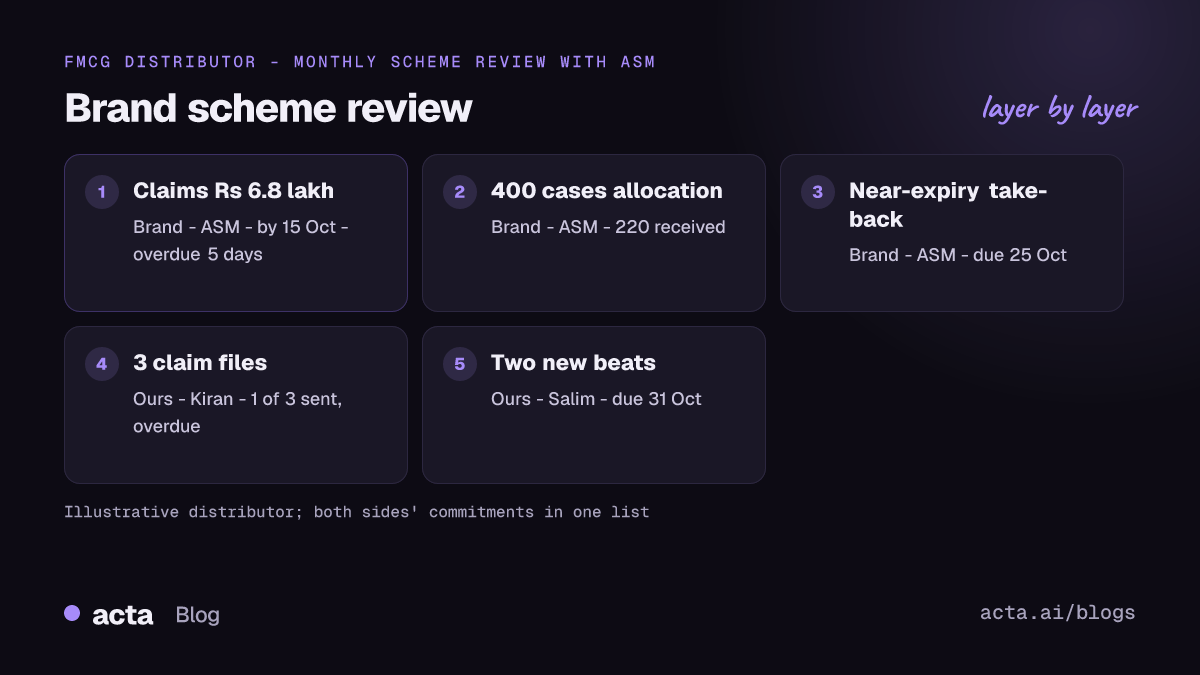
The fix is a list with two halves, written the day of the review. A simple action items tracker for a brand review looks like this:
| Action item | Side | Owner | Due | Status on 20 Oct |
|---|
| Settle Diwali scheme claims, about Rs 6.8 lakh, by credit note | Brand | Mr. D'Souza (ASM) | 15 Oct | Overdue 5 days |
| Allocate 400 cases of cream biscuit for festive week | Brand | Mr. D'Souza (ASM) | 12 Oct | Partly: 220 received |
| Take back 180 near-expiry cases via replacement claim | Brand | Mr. D'Souza (ASM) | 25 Oct | Due in 5 days |
| Submit three claim files with retailer-signed scheme sheets | Ours | Kiran (accounts) | 10 Oct | Overdue 10 days, 1 of 3 sent |
| Open two new beats on Wardha Road | Ours | Salim (sales manager) | 31 Oct | Open |
Two rules make it work. First, the brand's items carry the ASM's name, not "company". Second, your own items that the brand's promise depends on, like claim files, are marked as such: the brand will always point to them first. This is the heart of scheme claim settlement: a claim is only as strong as the paperwork date you can show.
On the credit note itself, the GST side has moved recently. The CBIC's Circular 251/08/2025-GST of September 2025 clarified how post-sale discounts are treated, including the difference between GST credit notes under Section 34 and financial or commercial credit notes, as summarised by EY and Taxmann. Ask in the review which kind the brand will issue, write the answer down, and check it with your CA. This is general information, not tax advice.
Acta tracks both sides of the review by meeting
Manoj records the review: in his office with the Acta mobile app on the table, or on Teams with the desktop app when the regional manager joins remotely, with no bot in the call. Acta writes the notes and pulls out action items with owners wherever a name was said, including the ASM's. The action item detection guide explains how owners and due dates are picked up.
Built-in templates that fit: Vendor review (the brand is your supplier), KPI review for the secondary sales numbers, and Contract negotiation for the annual terms discussion. On a paid plan, a custom template suits the monthly review:
Template name: Brand scheme review
What should this report do? For monthly reviews between our distributorship and a brand's sales team: claims, schemes, stock allocation, and the commitments each side made.
Sections: 1. Claims status (Table: Scheme, Period, Amount, Documents submitted on, Status). 2. Brand commitments (Checklist: task, owner, due date). 3. Our commitments (Checklist: task, owner, due date). 4. Stock and allocation (Table: SKU, Requested, Promised, Promised date). 5. Market feedback (Bullets). 6. Next review date (Paragraph).
When should Acta use it? Only matching meetings.
Across months, the tracker is My meetings > Outcomes > Action items. For brand reviews, group by Meeting: each review becomes a card with "N overdue", the date, an "X of Y done" bar and a one-line synopsis. Type "claim" in the search box to see every claim-related item across all reviews and both brands. The Due this week tile is the one to open a week before the next review.
The card's Follow-up email button writes a draft listing the meeting's items, which Manoj edits into the minutes he sends the ASM. For Bansal Trading's own people, the Auto follow-up setting does the nagging: "Send daily follow-ups" on Weekdays, "Who gets it" set to "Me, a summary of everyone's items" so Manoj sees the whole picture, and "Which items" set to All open. Kiran adds a comment on the claim-files item: "2 files with Prakash, retailer signatures pending". That comment, on 12 October, would have prompted Salim to send a salesman back to the two retailers.
The tracker is Manoj's: built from meetings he recorded and those shared with him. Kiran's view includes the review only if Manoj shares it with the workspace.
The Decision log, Risk Registry and OneChat settle disputes
Some outcomes are decisions, not tasks. "Diwali scheme extended to 15 November for modern trade outlets", decided by the ASM, sits in Outcomes > Decision log as Active, owner Salim, linked to the action "brief salesmen on extension". If the next ASM says the extension never applied to your territory, the card's History has the quote and the moment.
The near-expiry stock is a risk. In the Risk Registry tab: Risk "180 cases of cream biscuit expire in January; no take-back yet", Impact High, Mitigation "Brand to take back via replacement claim" tagged Agreed, Owner Mr. D'Souza, Date 25 Oct, Status Open. When the ASM is transferred and the date passes, the "Fix is overdue" card shows it.
On 4 November, before the review with the new ASM, Manoj opens OneChat and asks: "What did the biscuit brand promise us in the October review, and what is still open?" The answer lists the claim settlement by 15 October, the 400-case allocation (220 delivered per a later comment), and the stock take-back, with Found in pointing to the 4 October scheme review, each opening at the ASM's own words. Manoj can play the 15-second clip to Ms. Iyer. He also sees, honestly, that two claim files on his side were late. The conversation starts from facts instead of memory.
A minutes-and-reminder agent for scheme reviews
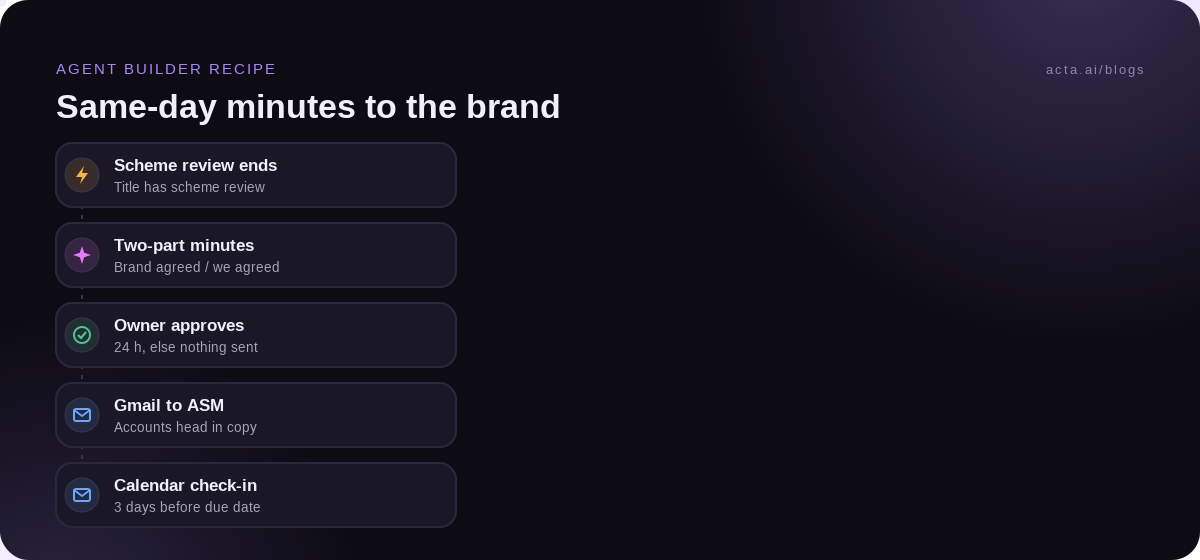
The habit that matters most is sending minutes to the ASM the same day. Agent Builder (beta) can draft them and book the check-in, waiting for Manoj's approval before anything leaves:
- Click New agent and describe it: "After every scheme review, email the ASM a two-part minutes note and book a check-in call before the earliest brand deadline." Or start from blank.
- Trigger: When a meeting ends, filter: title contains "scheme review".
- Acta data: get the meeting's notes and action items.
- AI: write the minutes in two parts, "What [brand] agreed" and "What we agreed", each line with owner and date, plus the claims table.
- Human approval: Manoj approves in the Approvals tab or from the email buttons. No answer in 24 hours, nothing goes.
- Action: Gmail, send to the ASM with Kiran in copy.
- Action: Google Sheets, add each claim line to your "Claims register" sheet.
- Action: Google Calendar, create an event with a Meet link three days before the earliest brand due date, titled "Check-in: claims and allocation".
- Test, Run test on the October review, read the draft, then Turn on.
The editor guide shows where each step goes. For more on drafting follow-ups after every call, see automating meeting follow-up emails.
Bring in sales and accounts over two weeks
A distributorship of 20 to 150 people rarely needs more than three to six seats in its workspace: the owner, the sales manager, the accounts head, and perhaps a manager per brand agency. Salesmen named as owners can get reminders by email. Set up the workspace in Settings > Workspace following the team setup guide, and share brand reviews and claims calls with Everyone in the workspace.
Week 1: tell the ASM at the start of the next review that you record reviews to keep accurate minutes, and offer to send them. Record that review. Build the custom template. Close the meeting by reading out both sides' commitments with dates. Send minutes the same day, by hand if the agent is not ready.
Week 2: record the weekly salesmen meeting and the claims reconciliation call. Turn on Auto follow-up. Build the minutes agent and test it on the recorded review. Before the next review, open the Due this week and Overdue tiles and write your questions.
Mistakes to avoid: tracking only your own team's items; letting the minutes go out a week late; recording a brand meeting without telling the ASM; and keeping the claims register in a separate file that nobody updates. On consent, read what to tell participants before recording; it is general information, not legal advice. Our FMCG distributors page has more examples.
Acta records meetings, writes notes and two-sided action items, and includes Outcomes, the Risk Registry and OneChat in the 15-day trial and on Pro ($8 per seat a month). It cannot make a brand pay a claim, but it can show exactly what was promised and when.
Frequently asked questions
How do I track what the brand promised, not just my team?
Make sure the ASM's name is said with each brand commitment, such as "D'Souza sir will settle by the 15th". Acta then lists the ASM as the item's owner. Group the Action items view by Meeting and each review shows both sides together. Send the minutes to the ASM the same day.
Will the ASM mind the review being recorded?
Some will, so ask at the start and explain why: accurate minutes for both sides. Offer to share the minutes. Most ASMs welcome a clear record, because it also protects them when they are transferred. If someone declines, take manual notes and enter the action items yourself.
Can salesmen without Acta seats receive reminders?
The Auto follow-up email can go to each owner with their own items, or to you as a summary of everyone's items that you pass on. Use Preview email to see what will go out. Salesmen outside the workspace need no seat for this; seats are only for the people you add to it, each of whom uses one whether they record or not.
What should distributor meeting minutes include for claims?
For each claim: scheme name, period, amount, the date documents were submitted, what is missing, who on each side owns the next step, and the promised settlement date. Note whether the brand will issue a GST credit note or a commercial one, and confirm the treatment with your CA.
Can I export the action items for my accountant?
The Decision log has an Export CSV button. For action items, the minutes agent can add each claim line to a Google Sheet, which your accountant can use directly. Template reports can also be downloaded as PDF, Word or Markdown.
Prepare for your next brand review
You do not need software to start. You need two columns, names on both sides, and minutes sent the same day.
- Split the list: brand commitments and your commitments, each with a named owner.
- Date the paperwork: record when each claim file was submitted, in the meeting.
- Send minutes in 24 hours: to the ASM, with your accounts head in copy.
- Check a week early: open the Due this week tile before the review.
- Clarify credit notes: ask which kind, then check with your CA.
Record your next scheme review with the Acta desktop app or mobile app, free for 15 days on Acta pricing.