Lab chains run on huddles, and TAT problems are spoken first
A diagnostic chain with a central processing lab and a ring of collection centres usually runs four kinds of operations meetings. The morning ops huddle at 8:30, often a Google Meet call with the operations head, the logistics manager, the central lab supervisor and the in-charge from each collection centre. The weekly TAT review, where the numbers from the LIS are discussed by centre and test group. A monthly B2B client review with hospitals, clinics and corporate health-check clients. And ad hoc calls when an analyser goes down or a run is missed.
The huddle is where sample logistics trouble surfaces first. A centre in-charge says "the 2 pm pickup was 40 minutes late again". Someone says the cool box on run 3 has no logger. The LIS admin mentions the overnight upload to a corporate client's portal failed twice. Each of these takes ten seconds to say and is easy to forget once the call moves on to staffing.
Setting expectations for TAT is a standard part of lab quality work. The WHO's Laboratory Quality Stepwise Implementation tool asks labs to determine a maximum allowed turnaround time for each examination, in discussion with the lab's clients, and to monitor it. And a published analysis on weekly laboratory turn-around time found that weekly reporting identified poor performance that aggregated reporting masked. For an ops head, the lesson is practical: look at the problem small and often, because the monthly average will tell you late.
The merged pickup run that cost a corporate contract its patience
An illustrative case. ClearPath Diagnostics runs a central processing lab and 11 collection centres across Jaipur, with about 230 staff. Vikram is head of operations, Salim manages logistics and the 14 riders, Rekha supervises the central lab's sample reception, Pooja leads client services and Harish runs the LIS. The central lab's same-day cut-off for routine biochemistry is 6 pm.
Week 1. To save rider costs, the weekly review decides to merge the two afternoon pickup runs from the four northern centres into one run leaving at 3:30 pm. Salim owns it. It looks fine on paper: 50 minutes to the central lab.
Week 2. In Tuesday's huddle, the Vidhyadhar Nagar in-charge says the merged run reached the lab at 6:20 because of traffic near the market. On Thursday, Rekha mentions that run 3's cool box has no temperature logger since the merge, because the logger stayed with the other rider's box. Both comments get a "noted".
Week 3. The merged run misses cut-off three days out of five. Routine samples from the north wait until the next morning. Nobody adds this up, because the chain-wide TAT figure barely moves: 11 centres are fine.
Week 4. A corporate client screening 2,000 employees at its Sitapura plant, whose camps are collected through a northern centre, emails Pooja: reports for the last two camps came a day late and employees are calling HR. The client's contract is up for renewal in two months.
Every warning was spoken in a meeting. None of them had an owner or a date, so none became a task.
A risk registry turns diagnostic lab operations meeting notes into early warnings
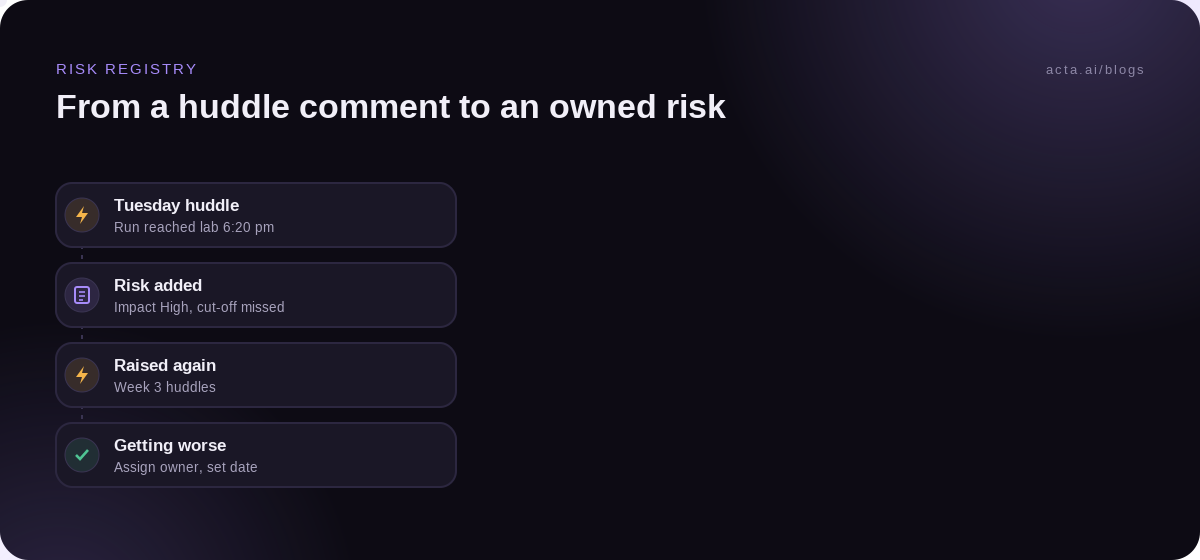
If Vikram records the huddles and weekly reviews, the Risk Registry tab in My meetings collects the risks raised in them and updates after every new meeting. A risk raised again later stays one row, with the newest details. Here is ClearPath's lab risk register as it would have stood at the end of week 2:
| Risk | Mitigation | Owner | Date | Impact | Status |
|---|
| Merged north pickup reaches central lab after 6 pm cut-off | Agreed: second rider for Vidhyadhar Nagar and Shastri Nagar on weekdays | Salim | Fri | High | Mitigating |
| Run 3 cool box has no temperature logger since merge | Suggested: move a spare logger from the reception stock | No owner | Not set | Medium | Open |
| Overnight upload to corporate client portal failing | Agreed: Harish to switch to the morning manual upload until fixed | Harish | Wed · overdue | Medium | Open |
| Sitapura screening client unhappy with report delays | Suggested: call the client's HR lead with dates and the fix | No owner | Not set | High | Open |
A few details make this more than a list. Agreed means the fix was decided in a meeting, and the play button opens the moment someone agreed it. Suggested means it is Acta's idea, not agreed yet, which is your cue to raise it at the next huddle. The impact level is High, Medium or Low, with a short line describing the impact. Status runs Open, Mitigating, Closed; when someone says in a meeting that the problem is solved, Acta shows a suggested status for you to confirm.
Above the table, up to three attention cards pick out what needs you today: High · no owner (the Sitapura client), Fix is overdue (the portal upload), and Getting worse (the merged run, once week 3's huddles mention it again). Each card has "Assign owner", "Change date", "Mark closed" and "See history". Group the table by Project / customer to see everything touching the Sitapura account, or by Owner to see Salim's load. "See history" shows how each risk changed, meeting by meeting.
Two cautions. The Risk Registry is Vikram's, built from the meetings he recorded or that were shared with him; Salim has his own. And it is an operational list, not your quality system's formal risk documentation. Use it to make sure what people said in meetings gets an owner, then carry anything formal into the system your quality manager keeps. For a wider view of how risks hide in ordinary conversation, see seven project risks hiding in everyday conversations.
A huddle template keeps runs, TAT and risks separate
Acta's built-in KPI review template suits the weekly TAT review, and Vendor review works for the quarterly call with your courier partner or reagent supplier. When an analyser or LIS outage needs a write-up, Incident post-mortem gives you timeline, cause and fixes. For the daily huddle, build a custom template (Pro) under Templates with "Create template":
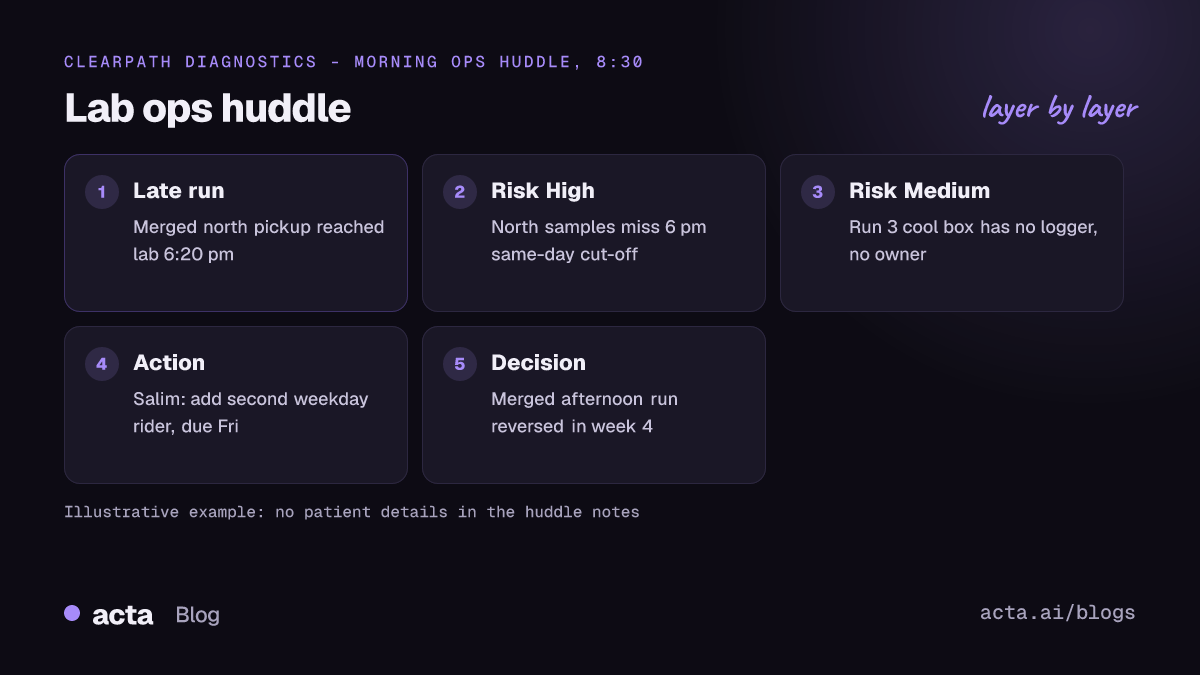
Template name: Lab ops huddle
What should this report do? For the morning operations huddle of a diagnostic lab chain: late runs, TAT exceptions by centre, equipment and LIS issues, operational risks and actions. No patient details.
1. Pickup runs (Table: Run, Centres, Left at, Reached lab at, Issue)
2. TAT exceptions (Table: Centre, Test group, Samples affected, Reason)
3. Equipment and LIS (Bullets)
4. Risks raised (Table: Risk, Raised by, Impact, Owner)
5. Actions (Checklist: task, owner, due date)
Extra instructions: Never include patient names, IDs or results. Use centre names as spoken.
Set "When should Acta use it?" to "Only matching meetings" and test it on a past huddle. The "Risks raised" table gives each risk a first appearance in the report, so even before you open the Risk Registry, the day's huddle notes show who raised what.
Decisions, actions and OneChat fill in the rest
Decision log
Vikram's Outcomes > Decision log would hold "Merge the two afternoon north pickup runs into one 3:30 pm run", decided by Vikram, owner Salim. When week 4's review restores the second run, its status moves to Reversed, and the history shows the week 1 quote alongside the reversal. That history is useful at budget time, when someone suggests merging runs again.
Action items
In Outcomes > Action items, grouped by Person, Salim's row reads: "Add second weekday rider for Vidhyadhar Nagar and Shastri Nagar", owner Salim, "Overdue 2 days", with a comment "rider joins Monday". Turn on Auto follow-up with "Each owner, their own items" and Overdue only, at 8 am on weekdays, so owners see their late items before the huddle.
OneChat
Ask OneChat: "How often did late arrivals of the north pickup come up in huddles this month, and who raised them?" A good answer: "Four times: Tuesday and Friday of week 2 (Vidhyadhar Nagar in-charge), Monday and Wednesday of week 3 (Rekha)." Found in lists the four huddles, each opening at the moment. Asking "What risks are open for the Sitapura account?" pulls the risk rows and the client review together. The OneChat help page explains scope.
A Monday agent posts the risk digest after approval
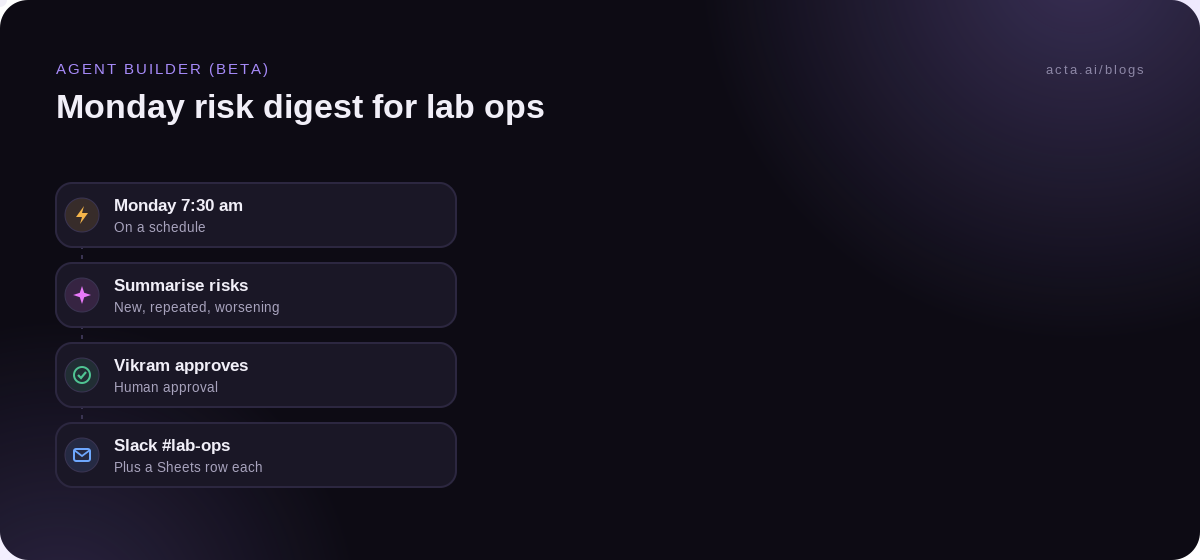
The register is only useful if someone looks at it. Agent Builder (beta) can bring it to the team every Monday, and nothing reaches the channel until the operations head approves it. Setting it up:
- Open Agent Builder, click "New agent", and describe it: "Every Monday, summarise last week's operational risks from lab huddles and post them to Slack after my approval."
- Trigger: On a schedule, Mondays at 7:30 am.
- Acta data: meetings from the last seven days with "huddle" or "TAT review" in the title.
- AI: "List risks raised, how many times each came up, owner, and whether it is new or getting worse. Three lines maximum per risk. No patient details."
- Human approval: Vikram approves in the Approvals tab or from the email buttons.
- Action: Slack, message to #lab-ops.
- Action: Google Sheets, add rows to a TAT-risk sheet for the monthly review.
- Test, Run test on last week, then Turn on.
A second, simpler agent: trigger Event in a connected app, Acta event "action item overdue", with a Slack message to the owner. If no one approves within 24 hours, nothing is sent. The steps guide lists every step type.
A two-week rollout across 12 centres
Only a few people need to record: the operations head (huddles and weekly review), the logistics manager (rider and courier calls) and the client services lead (B2B client reviews). Centre in-charges join the huddle as they do now. The huddle is on Google Meet, so the Chrome extension records it from the operations head's browser with no bot joining. Tell everyone on the call that it's recorded and why; our guide to recording consent and what to tell participants has wording. Do not record patient interactions at collection centres, and keep patient identifiers out of recorded ops meetings.
Week 1: Vikram records every huddle and the weekly TAT review. On day 3 he builds and tests the Lab ops huddle template. On day 5 he reads the Risk Registry and assigns owners to anything High.
Week 2: invite Salim and Pooja from Settings > Workspace (roles: Member). Share every huddle with "Everyone in" the workspace so Salim's own register and OneChat include them. Turn on Auto follow-up. On day 10 build the Monday agent. On day 14, a 20-minute review: which risks closed, which owners never update.
Mistakes to avoid: discussing individual patients in the huddle, recording the whole lab floor, and treating "Suggested" mitigations as agreed. Acta's role is simple: it records the huddle, writes the notes and keeps the risk list current. Your team still decides what to do about each risk. The Acta for diagnostic labs page has a short summary.
Frequently asked questions
What should a daily lab operations huddle cover?
Pickup runs and late arrivals, TAT exceptions by centre and test group, equipment and LIS issues, staffing gaps, client escalations, and any new risks with an owner. Keep it to 15 minutes and keep patient details out. Close by reading back the actions with owners, so the notes and the people agree on who does what.
How do I spot a TAT problem before clients complain?
Review TAT weekly by centre and route, not as a monthly chain-wide average, and log every late run mentioned in a huddle as a risk. Published analysis found weekly reporting exposes poor performance that aggregated figures mask. A risk mentioned twice in a week is your signal to assign an owner and a fix date.
Is a risk register the same as our quality risk documentation?
No. The Risk Registry in Acta collects operational risks raised in meetings so they get owners and dates. Your quality system's formal risk records are separate and follow your own procedures. Use the meeting register as an early warning list, and move anything that needs formal handling into your quality manager's system.
Can centre in-charges see the risks without recording anything?
Each person's Risk Registry is built from the meetings they recorded or that were shared with them. If the operations head shares huddles with the workspace, invited members can open those meetings and ask OneChat about them. Every invited member uses a seat, so many chains invite only the operations head and lab managers who run the huddles, and send risk digests to the rest through Slack.
Should we record calls with hospital and corporate clients?
It helps, because client reviews are where TAT expectations and complaints are agreed. Tell the client at the start, explain why, and avoid discussing individual patients. Consent rules vary by place, so this is general information, not legal advice. The desktop app or Chrome extension records from your computer without adding a bot.
Use this week's huddle as the pilot
You'll know within five working days whether the register catches things your current notes miss.
- Record five huddles: Monday to Friday, operations head only.
- Keep patients out: centres, runs, test groups and counts, never names or results.
- Own the High risks: every High row gets a person and a date by Friday.
- Read by centre: check TAT per route weekly, not the chain average.
- Automate the digest: the Monday agent posts after approval, from week 2.
Start a 15-day trial and record tomorrow's huddle with the Chrome extension, or the desktop app if your team meets on Zoom or Teams.