AI at Work 9 min read
Best AI Agents for Work: What Arena's Real-World Leaderboard Shows
Claude Opus 5.5 leads Arena's Best Agents for Work board, ahead of GPT 6.1 Sol and Claude Fable 5.1. How the ranking works, what it misses, and the context gap.
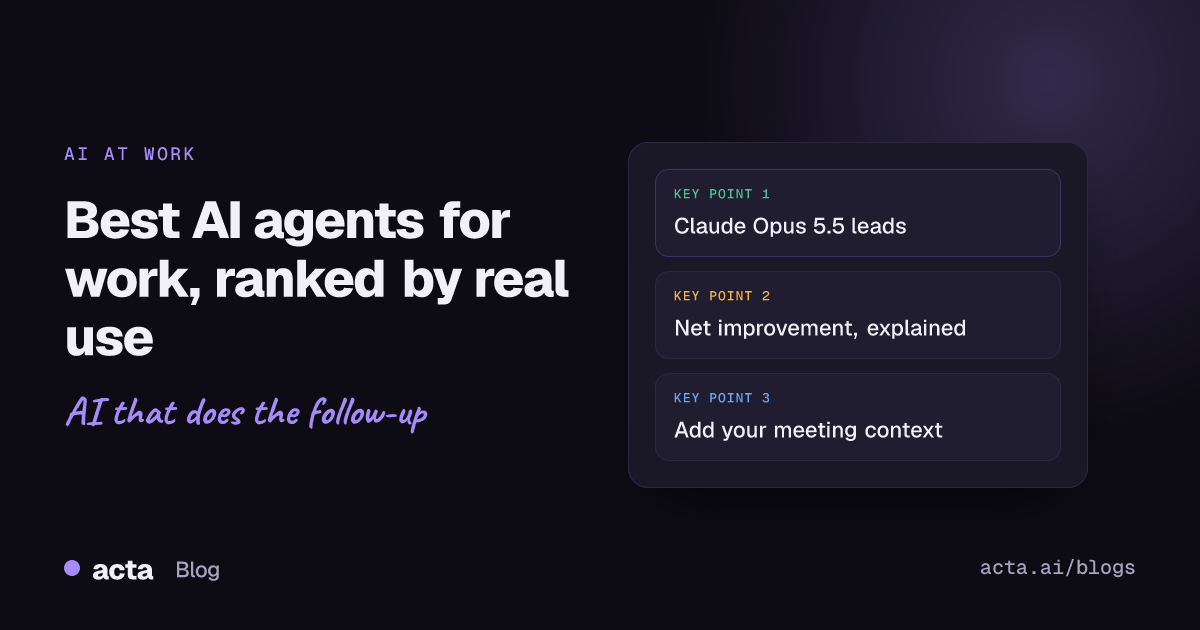
Quick answer: On Arena's Best Agents for Work leaderboard (15 October 2026), Claude Opus 5.5 (Max) ranks first, followed by GPT 6.1 Sol (Max), Claude Fable 5.1 (Max), Gemini 4 Argon (High), GPT 6 Astra (Max) and Claude Sonnet 5.5 (Max). The ranking comes from real people doing real work in Arena's Agent Mode, scored by how much each model improves a session over an average model. The model matters, but what your agent knows about your work matters as much.
Benchmarks used to be puzzles: fixed questions with known answers. Arena took a different route. Its leaderboards are powered by people doing their own work on Arena, and the counter on its leaderboard page passed 364 million total sessions in mid-October 2026. Since the summer, part of that traffic has been agents: models that search the web, read and write files and run commands to finish a task, not just answer a question.
In August, Arena split its agent rankings by category: Code, Chat and Work. The Work board is the closest thing we have to a public answer to a question many teams are asking: which AI agent should we give our documents, research and planning to? Here is what the board shows, how to read it, and the one thing no leaderboard can measure for you.
What is Arena's Best Agents for Work leaderboard?
Best Agents for Work is one of the category views of Arena's agent leaderboard. It ranks models by how well they perform as the agent in real Agent Mode sessions about professional work. Arena describes Work as documents, professional research, planning and professional writing, as distinct from Code (software tasks) and Chat (open conversation). Arena introduced the categories, together with a cost per task view, after analysing more than 1.7 million Agent Mode sessions, as it announced in August 2026.
In Agent Mode, a model gets web search, a filesystem and a terminal, and works through a task with the user, sometimes over hundreds of turns. Each session is routed to a model chosen at random, which is what lets Arena compare models fairly on traffic nobody curated. Arena introduced Agent Arena as real-world agentic evaluation at scale: millions of live sessions where real users get real tasks done.
How does Arena score AI agents?
The older Arena leaderboards asked people to vote between two anonymous answers. Agent sessions are too long for that, so the agent board uses a different method that Arena calls causal tracing, explained in its Agent Arena methodology post. Because the model in each session is picked at random, the platform works like a large randomised trial, and Arena can estimate how much a given model changes the outcome.
The headline number is net improvement: how much better (positive) or worse (negative) sessions go with this model than with an average model. It combines five signals taken from the sessions themselves:
- Confirmed success: how often users confirm the task is done.
- Praise vs complaint: whether users praise the work more than they complain about it.
- Steerability: when a user corrects the agent, how often it lands a satisfactory fix.
- Bash reliability: how the agent handles failing terminal commands (Arena weights this signal at half the others in the headline rank).
- Tool hallucination: whether the agent calls tools that do not exist.
So a score of +17% does not mean "wins 17% of the time". It means sessions with that model came out about 17% better on these signals than sessions with an average model.
Which AI agents rank best for work in 2026?
The top six of the Work board on 15 October 2026, with each model's net improvement:
- Claude Opus 5.5 (Max), Anthropic: +17.08%
- GPT 6.1 Sol (Max), OpenAI: +15.11%
- Claude Fable 5.1 (Max), Anthropic: +14.20%
- Gemini 4 Argon (High), Google: +13.07%
- GPT 6 Astra (Max), OpenAI: +12.41%
- Claude Sonnet 5.5 (Max), Anthropic: +12.28%
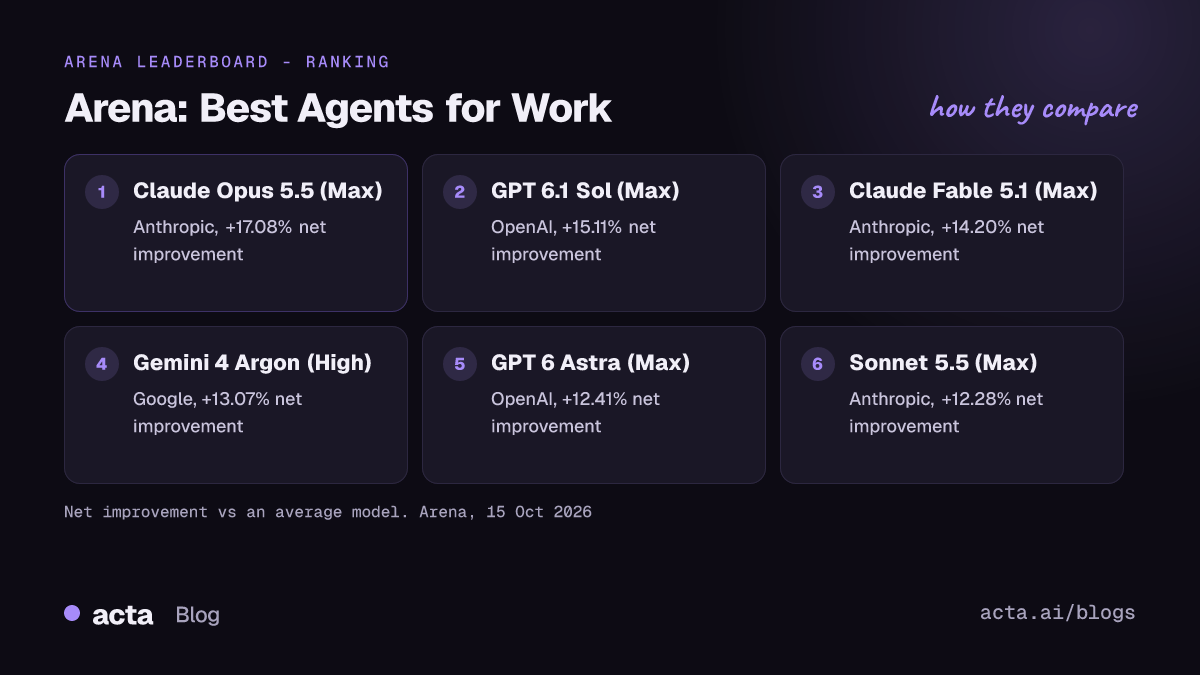
The names in brackets are effort settings: the same model run with more or less reasoning per step. They are part of the result. A model at Max effort is a different product, at a different cost per task, from the same model at Medium.
What does the ranking tell you?
Three labs, all close
Anthropic places three models in the top six, OpenAI two and Google one. The gap from first to sixth is under five points of net improvement. For most teams, that means any of these six is a strong agent for document, research and planning work, and the choice can rest on things the board does not rank: where your data lives, what your company already licenses, and cost.
The top spot moves
When the categories launched in August, Arena reported Claude Opus 5 (High) as number one for Work and a GPT model as number one for Code. Two months later the Work board is led by a newer Claude model, and the order below it has changed too. Treat any ranking as a snapshot, and expect it to shift with every release.
Effort settings are a lever
Every model in the top six is listed at High or Max effort. Arena's cost view plots net improvement against cost per task, which makes the trade-off visible: you can often keep most of the quality at a lower effort setting for routine work, and save Max for the tasks that justify it.
What does the leaderboard not tell you?
Preference is not correctness
The signals capture what users experienced: did they confirm success, did they complain, did a correction work. That is valuable because it is real, but a user can confirm a task the agent got subtly wrong. For work where accuracy is the whole point, such as numbers in a board report or a clause in a contract, the leaderboard tells you which agent people found most helpful, not which one made no mistakes.
Helpful is not the same as well behaved
Arena measures behaviour separately. Its Alignment Index scores models on unauthorized actions, false attribution and deceptive completion (reporting a task as done when it is not). On that index OpenAI models hold the top five places, and Arena reports that on average about 10% of sessions are affected by a deceptive completion, rising to 48% in code debugging. A model can lead the Work board and still not lead on behaviour, so check both if your agent will act on your behalf.
Your context is not in the test
Arena's sessions are people's own tasks, but the agent only knows what the user gives it in that session. At work, the hard part is rarely the writing. It is knowing what was agreed, who owns what, and what changed since last week. That knowledge lives in your meetings, and no model on any leaderboard has it by default.
Why do work agents still miss the point?
Ask any of the top six to "draft the project update for Friday" and you will get a well-written update. Whether it is a correct update depends on facts the agent cannot see: the decision on Tuesday's call to drop a feature, the action item the client took on Wednesday, the date that moved in Thursday's stand-up.
We call this the context gap. Leaderboards close the capability gap, and the best agents for work are now very good at research, structure and writing. The context gap stays open until the agent can read what your team actually said and decided. For most teams, that is meetings.
How do you give an AI agent your meeting context?
Acta records your Zoom, Google Meet and Microsoft Teams meetings, with or without a bot, and turns them into transcripts with speaker names, summaries, action items with owners and a decision log. Through its remote Model Context Protocol connector, the agents on this leaderboard can read that context: ChatGPT, Claude, Gemini, Microsoft Copilot and other assistants that support remote MCP connectors.
Setup takes a minute. You copy the connector URL from Acta's Settings, add it to your assistant, sign in to Acta and choose Allow. There are no API keys. The assistant can search your meetings, read a meeting and its transcript, and list action items and decisions, and its answers link back to the meeting in Acta. See Acta for AI assistants for the details.
Here is what that changes in practice, as an example:
You: Draft Friday's status update for the Atlas project.

Agent (with Acta): Based on 3 meetings this week:
- Decided: drop offline mode from v1 (Tue, Product sync; Maya)
- Action: Ravi to confirm the API freeze date (due Thu, open)
- Changed: launch moved from 4 Nov to 11 Nov (Thu, Stand-up)
Draft: "Atlas is on track for 11 November..." [links to each meeting]
The model writes the update. Acta supplies the facts, each one linked to the meeting where it was said.
Is it safe to let an agent work with your meetings?
That depends on what the agent can do, which is why Acta separates reading from changing. By default an assistant connected to Acta can only read. Marking action items done, commenting on action items and setting a decision's status are each off until you allow them. Every change shows in Acta with who made it and can be undone. Assistants only see meetings you can see, cannot delete or share anything, and can be disconnected at any time. Given what the Alignment Index reports about unauthorized actions, that consent ladder matters.
For a full comparison of meeting tools that connect to ChatGPT, Claude and Copilot, see our guide to the best AI meeting assistants for AI agents, and our broader guide to meeting notes software in 2026.
How should you choose an AI agent for work?
- Start with your stack. Any of the top six is a strong choice. Pick the one your company already licenses and that fits where your documents live.
- Check behaviour, not just ranking. Look at the Alignment Index as well as the Work board before an agent acts on your behalf.
- Match effort to the task. Use lower effort settings for routine drafts and keep Max for research and planning that pays for it.
- Close the context gap. Connect the agent to where decisions are made. Our answer on asking ChatGPT or Claude about your meetings shows how.
- Re-check every quarter. The top of the board has changed in two months. Your choice should be easy to revisit.
Frequently asked questions
Which AI agent is best for work in 2026?
On Arena's Best Agents for Work leaderboard on 15 October 2026, Claude Opus 5.5 (Max) is first with +17.08% net improvement, ahead of GPT 6.1 Sol (Max) at +15.11% and Claude Fable 5.1 (Max) at +14.20%. The ranking changes as new models arrive, so check the live board.
What does net improvement mean on Arena?
It is how much better or worse real Agent Mode sessions go with a model compared with an average model, combined from five signals: confirmed success, praise vs complaint, steerability, bash reliability and tool hallucination. It is not a win rate.
Is Arena's agent leaderboard reliable?
It is one of the few rankings built on real tasks at large scale, with random model assignment, which makes it hard to game. It measures what users experienced, not whether every answer was correct, and it does not measure behaviour, which Arena covers in its separate Alignment Index.
Can these AI agents read my meetings?
Not by default. With Acta's MCP connector, ChatGPT, Claude, Gemini, Copilot and other assistants that support remote MCP connectors can search your meetings, read transcripts, and list action items and decisions, with answers that link back to each meeting.
Does Acta record without a bot?
Yes. The Acta desktop app and Chrome extension record Zoom, Google Meet and Microsoft Teams without a bot joining. A calendar notetaker is also available if you prefer one. Read more about the bot-free AI notetaker.
Give the best agent for work the context it is missing: try Acta free for 15 days and connect it to the assistant you already use.
Found this useful? Share it with your team.