Technology 4 min read
How We Cracked the Multi-Meeting RAG Challenge
Transforming Enterprise Conversations into Organizational Intelligence
Enterprise knowledge is rarely stored in a single document.
It is spread across sales calls, customer meetings, product reviews, leadership discussions, project updates, support escalations, and countless other conversations happening every day.
While Large Language Models (LLMs) have made it easier to search and summarize information, organizations still struggle with a fundamental challenge:
How do you retrieve insights from hundreds or thousands of meetings and generate a single, accurate answer?
At Acta, we faced this challenge while building our AI-powered Meeting Intelligence platform. Traditional Retrieval-Augmented Generation (RAG) architectures were not designed to reason across months of conversations distributed throughout an organization.
This article explains how we built a Multi-Meeting RAG architecture that transforms fragmented discussions into actionable organizational intelligence.
The Problem with Traditional RAG
Traditional RAG systems work well for:
PDF documents
Knowledge bases
Policies and procedures
Product documentation
Structured repositories
The process is straightforward:
Convert documents into chunks
Generate embeddings
Store them in a vector database
Retrieve relevant chunks
Send context to an LLM
Generate a response
However, meetings create a different challenge.
Consider the question:
"What concerns have enterprise customers raised about pricing during the last six months?"
The answer may exist across:
Customer discovery calls
Sales pipeline reviews
Executive business reviews
Product roadmap discussions
Customer support escalations
No single meeting contains the complete answer.
Traditional RAG retrieves individual chunks but struggles to understand relationships across hundreds of conversations.
Why Meeting Data is Different
Meeting data has several unique characteristics:
1. Information is Distributed
Critical insights are spread across multiple meetings rather than centralized in one document.
2. Context Evolves Over Time
Customer concerns discussed in January may evolve significantly by June.
3. Multiple Perspectives Exist
Sales teams, product managers, executives, and customers may discuss the same topic differently.
4. High Volume
Large organizations generate thousands of meeting transcripts every month.
These challenges require a more sophisticated approach than standard document retrieval.
Our Multi-Meeting RAG Architecture
To solve this problem, we designed a hierarchical retrieval framework that operates at multiple levels of intelligence.
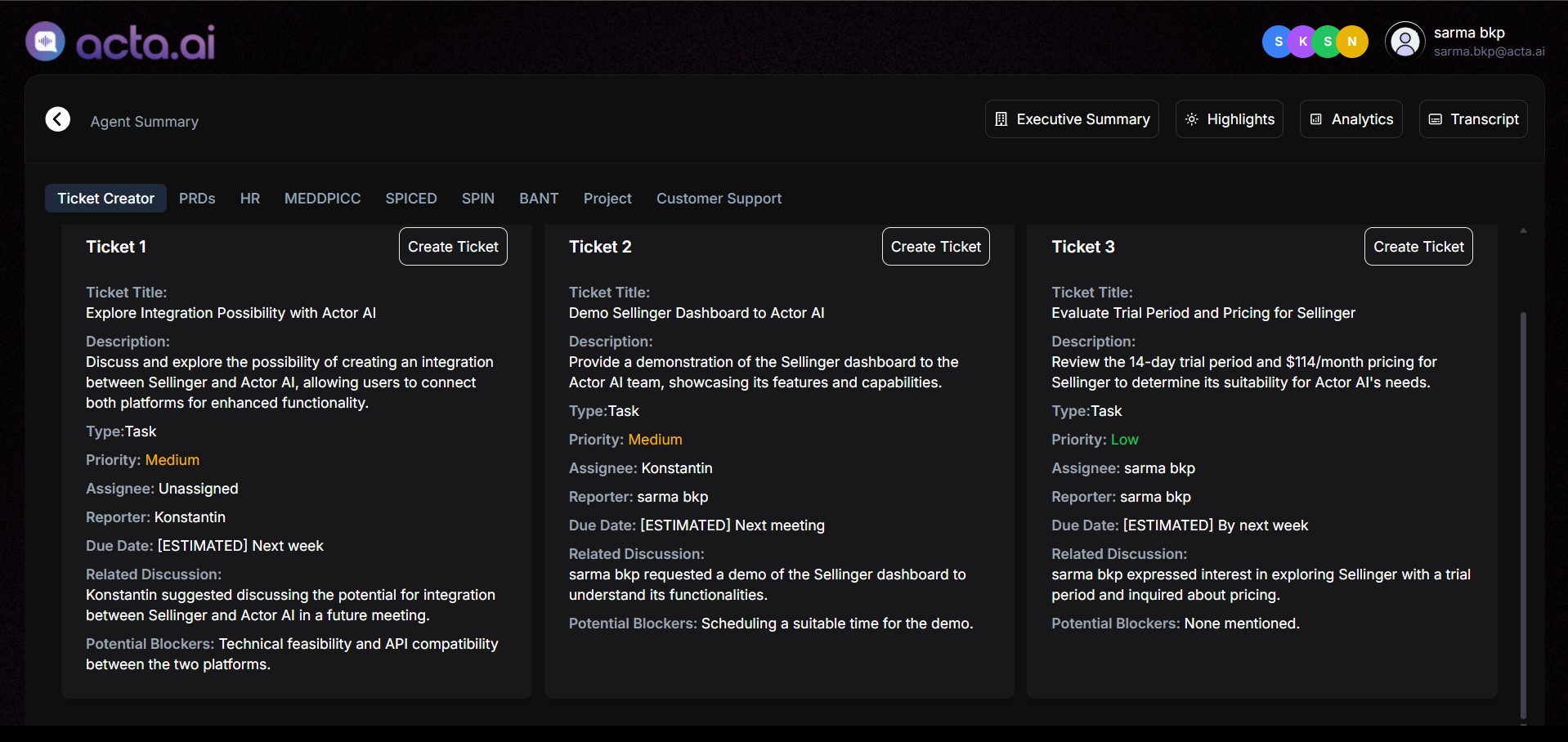
Layer 1: Meeting Intelligence Extraction
Each meeting is processed through an AI pipeline that extracts:
Key topics
Decisions
Risks
Action items
Customer feedback
Business entities
Sentiment signals
Strategic themes
Rather than storing raw transcripts alone, we generate structured business knowledge.
For example:
Meeting Transcript → AI Processing → Business Knowledge Objects
This creates a richer foundation for retrieval.
Layer 2: Knowledge Aggregation
The next challenge is connecting related information across meetings.
We group semantically similar discussions into organizational themes.
For example:
Pricing Strategy
Sales Call #124
Customer Review #201
Product Meeting #330
Leadership Review #412
Instead of treating these as separate conversations, they become part of a shared knowledge graph.
This significantly improves retrieval quality.
Layer 3: Multi-Level Retrieval
When a user asks a question, retrieval occurs across multiple knowledge layers.
The system searches:
Raw meeting transcripts
Meeting summaries
Decisions
Action items
Aggregated themes
Organizational knowledge structures
This approach dramatically increases recall while reducing irrelevant information.
Layer 4: Context Optimization
One of the biggest limitations of LLMs is context window size.
Sending hundreds of meeting chunks directly to a model is expensive and ineffective.
We solve this by:
Ranking relevance
Removing duplication
Consolidating similar insights
Prioritizing authoritative sources
The model receives only the most valuable context.
Layer 5: AI Reasoning and Synthesis
Finally, the LLM synthesizes information across multiple conversations.
Instead of answering:
"Meeting A discussed pricing."
The system can answer:
"Across 43 meetings conducted over the last six months, the three most common pricing concerns were discount flexibility, enterprise licensing complexity, and competitive positioning."
This transforms conversation search into business intelligence.
Benefits of Multi-Meeting RAG
Better Retrieval Accuracy
The system understands relationships across conversations rather than relying on isolated transcript fragments.
Reduced Hallucinations
Answers are grounded in verified organizational knowledge.
Lower Inference Costs
Optimized retrieval reduces token consumption.
Organizational Memory
Knowledge remains accessible even when employees leave the organization.
Executive Decision Intelligence
Leaders can identify patterns, trends, risks, and opportunities across the entire business.
Beyond Meeting Notes
Most meeting assistants focus on transcription and summarization.
While useful, summaries only capture what happened in a single conversation.
The next evolution is Organizational Intelligence.
Organizations need answers such as:
What are customers consistently requesting?
Which product risks appear repeatedly?
What commitments were made across teams?
What decisions have changed over time?
Which opportunities are gaining momentum?
Answering these questions requires reasoning across thousands of conversations.
That is where Multi-Meeting RAG becomes essential.
The Future of Enterprise AI
As enterprises continue adopting Generative AI, the competitive advantage will not come from access to larger language models alone.
It will come from how effectively organizations can transform their internal knowledge into actionable intelligence.
The future belongs to systems that can:
Retrieve information accurately
Connect knowledge across silos
Understand organizational context
Support decision-making at scale
At Acta, we believe Multi-Meeting RAG is a foundational building block for that future.
Because enterprise AI should not simply remember conversations.
It should understand them, connect them, and turn them into decisions.
About Acta.ai
Acta is an AI-powered Meeting Intelligence and Organizational Knowledge platform that helps businesses transform conversations into actionable insights. Using advanced Retrieval-Augmented Generation (RAG), AI Agents, and enterprise-grade AI architecture, Acta enables organizations to unlock the full value of their collective knowledge.
Learn more at www.acta.ai.