Business 5 min read
From Prompt Engineering to AI Systems Engineering
A few years ago, if you could write a good prompt, you were considered an AI expert.
People discovered that changing a few words could dramatically improve AI responses. Organizations started creating prompt libraries. Teams shared prompt templates. Entire courses emerged around Prompt Engineering.
And for a while, it worked.
But as businesses began deploying AI into real-world operations, they discovered something important:
A great prompt can generate a great answer. It cannot guarantee a great outcome.
That's where the industry is today.
And that's why AI is entering a new phase of maturity.
The Same Journey Software Engineering Experienced
The AI industry today reminds me of software engineering twenty years ago.
In the early days, building software was primarily about writing code.
If the code worked, the job was considered done.
But as systems became larger and more critical to business operations, organizations realized that writing code was only one small piece of the puzzle.
Success depended on:
Architecture
Scalability
Security
Reliability
Monitoring
Governance
User Experience
Today, nobody evaluates a banking platform, e-commerce application, or enterprise ERP system based solely on how much code was written.
We evaluate whether the entire system delivers business value reliably and at scale.
AI is now following the exact same path.
Phase 1: Prompt Engineering
The first wave of AI adoption focused on prompts.
The thinking was simple:
"If we ask better questions, we'll get better answers."
And that was absolutely true.
A well-crafted prompt could improve:
Summaries
Reports
Emails
Content generation
Coding assistance
Prompt Engineering helped people unlock the power of large language models.
But organizations quickly discovered its limitations.
Imagine asking an AI:
"What should we do to improve customer retention?"
The AI might provide a reasonable answer.
But does it know:
Your customer history?
Your churn data?
Your product roadmap?
Your support tickets?
Your business goals?
Of course not.
The problem was no longer the prompt. The problem was the lack of context.
Phase 2: Context Engineering
This led to the next evolution:
Context Engineering.
Instead of focusing only on prompts, organizations began asking:
"How do we provide the right information to the AI at the right time?"
This changed everything.
Rather than relying on the model's generic knowledge, companies started enriching AI with:
Enterprise documents
Customer information
Historical decisions
Product knowledge
Business processes
Organizational memory
The workflow became:
Question + Business Context = Better Answer
This is why technologies such as:
RAG (Retrieval-Augmented Generation)
Vector Databases
Knowledge Graphs
Semantic Search
AI Memory Systems
have become foundational to modern AI applications.
Context Engineering made AI smarter.
But it still left one critical question unanswered.
What Happens After The Answer?
Let's assume AI generates a perfect answer.
Now what?
Someone still needs to:
Create tasks
Update systems
Assign owners
Trigger workflows
Track execution
Measure outcomes
And that's where most AI implementations stop.
The AI generates content.
Humans do the rest.
But businesses don't buy AI to generate content.
They invest in AI to improve outcomes.
This is where AI Systems Engineering enters the picture.
Phase 3: AI Systems Engineering
AI Systems Engineering is the discipline of building complete business systems around AI.
Instead of asking:
"Can AI generate a response?"
we ask:
"Can AI help drive a business outcome?"
The focus shifts from models to systems.
From answers to actions.
From intelligence to execution.
What Does an AI System Actually Look Like?
Let's take a simple example.
Traditional AI
Meeting ↓ AI Summary ↓ Action points
Useful. But limited.
Now look at an AI system.
AI Systems Engineering
Meeting ↓ Transcription ↓ Context Retrieval ↓ Decision Identification ↓ Action Item Extraction ↓ Owner Assignment ↓ Project Updates ↓ Notifications ↓ Progress Tracking ↓ Business Outcome
Notice the difference.
The AI summary is only one step.
The real value comes from everything that happens after.
The AI becomes part of a larger operational system.
A Real Business Example
Imagine a product review meeting.
During the discussion:
A customer escalation is raised.
A new feature is approved.
A delivery risk is identified.
Several actions are assigned.
In a traditional environment:
Someone writes notes.
Someone creates tickets.
Someone updates project plans.
Someone sends follow-up emails.
And sometimes things get forgotten.
In an AI System:
The conversation becomes the starting point.
The system automatically:
Captures decisions
Extracts action items
Creates project tasks
Updates delivery systems
Sends notifications
Tracks completion
The focus is no longer on documenting conversations.
The focus is on ensuring conversations become outcomes.
The Missing Piece: Organizational Memory
Every company has experienced this.
A decision is made.
Everyone agrees.
The meeting ends.
A few weeks later someone asks:
"Why did we decide that?"
Nobody remembers.
The notes exist somewhere.
The context is gone.
The reasoning is lost.
This is becoming one of the most important opportunities for AI.
Not simply generating content.
But preserving organizational memory.
Helping teams understand:
What decisions were made
Why they were made
Who was involved
What actions were agreed
Whether execution actually happened
The future of enterprise AI will increasingly revolve around transforming conversations into institutional knowledge and operational momentum.
Why Governance Matters
As AI becomes part of business-critical processes, another challenge emerges:
Trust.
Organizations need answers to questions such as:
Is the information accurate?
Where did it come from?
Who approved it?
Can we audit it?
Is sensitive data protected?
Are humans still in control?
This is why governance is becoming just as important as models. The most successful AI systems won't necessarily have the smartest models. They will have the strongest combination of:
Intelligence
Reliability
Security
Transparency
Human oversight
The Future Belongs to AI Systems
For the last two years, much of the AI conversation has focused on prompts.
Today, the conversation is shifting toward context.
Over the next decade, the biggest opportunities will belong to organizations that master systems.
Because business leaders don't care about prompts.
They care about outcomes.
The future won't belong to the organizations with the most sophisticated prompts.
It will belong to the organizations that can combine:
Models
Context
Data
Workflows
Governance
Human Oversight
into reliable AI systems that create measurable business value.
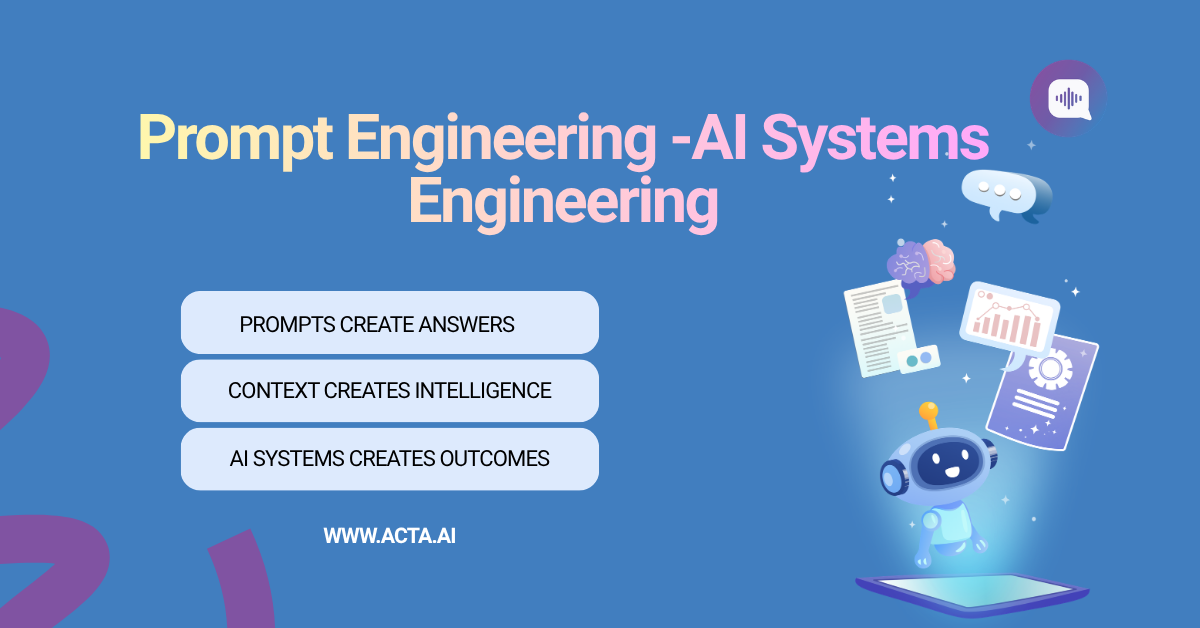
Prompt Engineering was the beginning.
Context Engineering is the present.
AI Systems Engineering is the future.
And just as software engineering evolved from writing code to building resilient systems, AI is now embarking on the same journey.
The companies that understand this shift early won't simply use AI.
They will redefine how work gets done.