Use Cases 6 min read
Dealflow Memos From Founder Pitch Meetings, Written for Investors
How Acta writes a short VC dealflow memo from each pitch meeting, covering team, market, traction and the round, so partners can triage deals quickly.
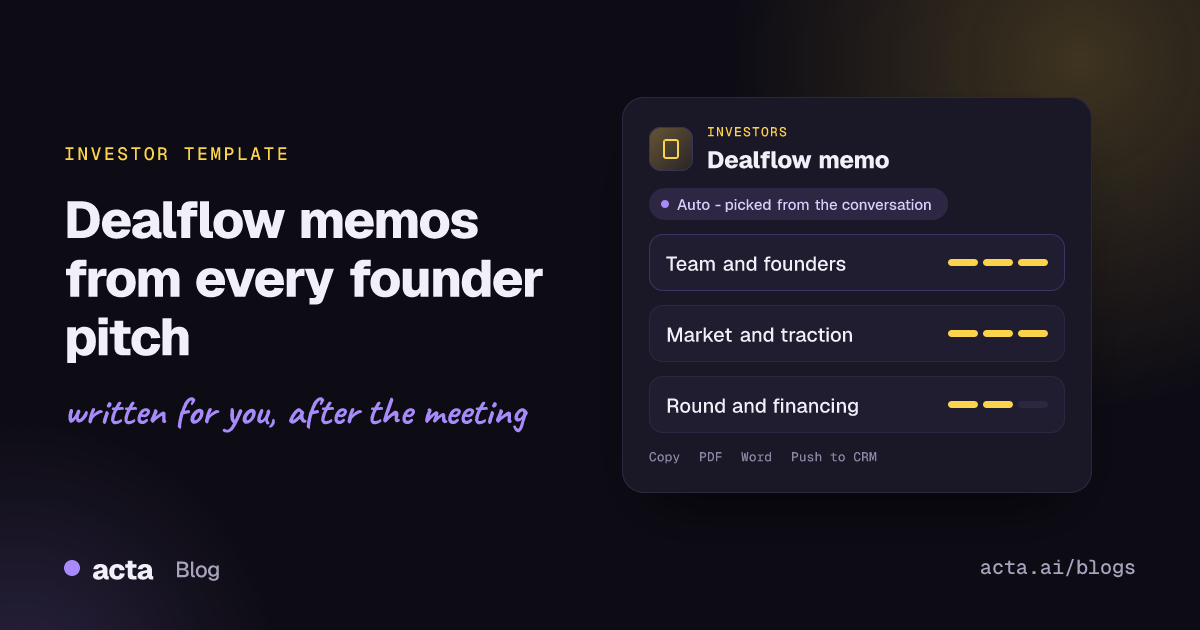
Quick answer: A dealflow memo is a short investment memo written after a founder pitch: company overview, team, problem and solution, market, competition, traction and the round being raised, topped with a TLDR. Acta writes it from the recording of the pitch meeting, using only what the founders said, so you can triage the deal or share it with partners within minutes of hanging up.
A busy investor can take a dozen first meetings a week. Each one deserves a write-up for the partner meeting or the CRM, yet most get a few bullet points typed between calls, or nothing at all.
The cost shows up later. A partner asks what the churn numbers were, or whether the round had a lead, and the answer lives only in someone's memory. Writing the memo from the conversation means every pitch leaves a record that is consistent, searchable and ready to discuss.
What is a dealflow memo (and how does it differ from an investment memo)?
In venture capital, an investment memo is the document a deal team writes to argue for or against an investment. Carta's guide to investment memos describes the usual contents: the business model, the market, the management team, the deal terms and the main risks. A full memo for an investment committee can run many pages and draws on diligence well beyond a single meeting.
A dealflow memo is the earlier, lighter version. It captures the first or second conversation with a founder so the firm can decide whether to spend more time on the company. Think of it as the screening note that feeds the pipeline: enough structure to compare companies side by side, short enough to read in two minutes.
The questions it answers are the classic early-stage ones. Who is the team and why are they the right people? What problem do they solve, for whom, and how big is that market? Who else is doing it? What traction do they have? How much are they raising, on what terms, and who else is in?
What does Acta's dealflow memo include?
The dealflow memo template analyses the pitch meeting and pulls out what an investor needs to make the next call. It covers:
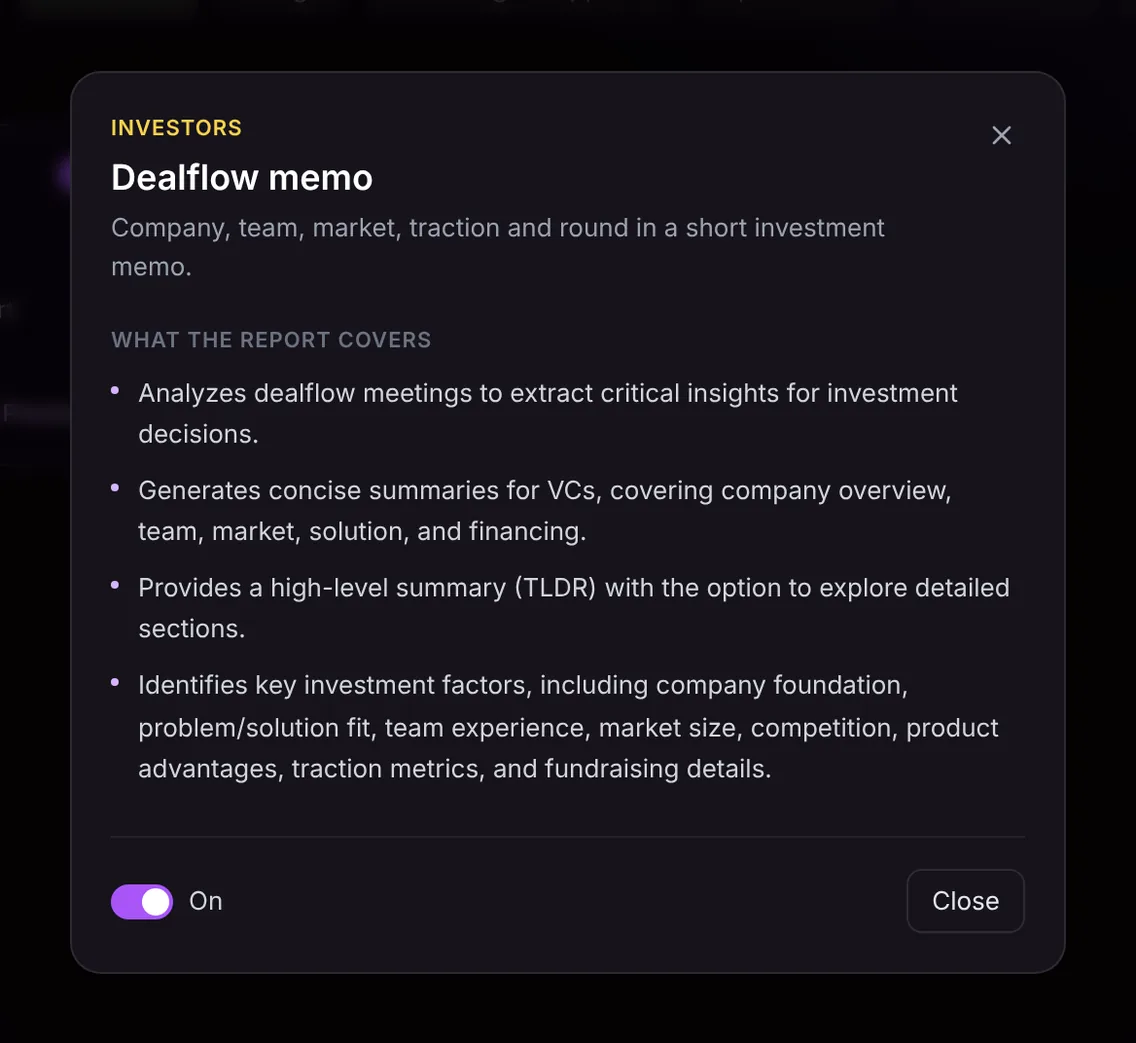
- TLDR: a high-level summary at the top, so you can decide quickly whether to read the detail.
- Company overview and foundation: what the company does, when and how it started, and where it is based, as the founders described it.
- Team: founders and key hires, their relevant experience and how they divide the work.
- Problem and solution: the pain they target and how the product solves it, including problem/solution fit.
- Market and competition: market size as the founders framed it, the customers they go after and the competitors or alternatives they named.
- Product advantages: what they claim sets them apart, such as technology, data or distribution.
- Traction metrics: revenue, growth, customers, pilots, retention or usage figures mentioned on the call.
- Financing: the round size, instrument, valuation if shared, existing investors and use of funds.
Each section is short, and anything the founders did not cover is left out rather than filled with guesses. That makes the gaps visible, which is often the most useful part for diligence.
Here is the template in Acta's Templates page, with the preview of what the report covers:
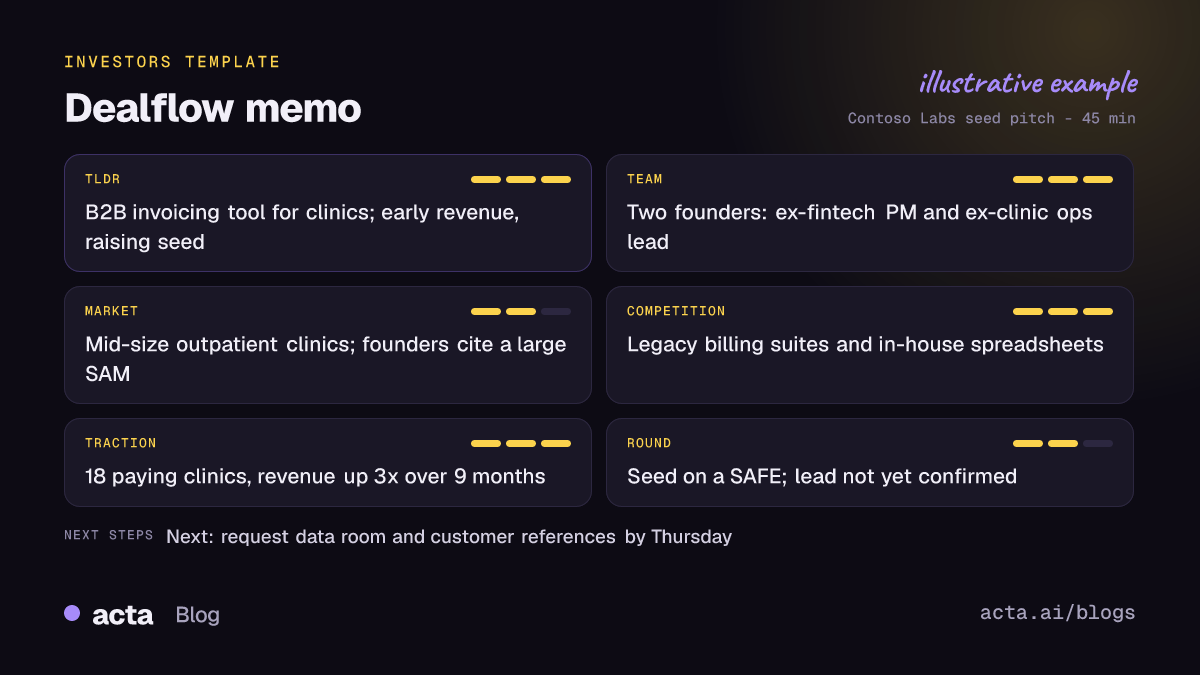
And an illustrative example of a finished report:
Why is a dealflow memo useful, and who is it for?
The template is built for venture capitalists, angel investors, associates and anyone running a deal pipeline, including corporate venture teams and accelerator programme managers.
- Partner meetings: the associate who took the call can bring a memo in the same format as every other deal, instead of a verbal summary.
- Screening at volume: during a busy fundraising season, the TLDR lets you sort which companies merit a second meeting.
- Following up months later: when a founder comes back for the next round, you can compare what they promise now with what they said last time.
- Angel syndicates: a lead angel can share a consistent memo with co-investors who were not on the call.
The time saved is the obvious benefit, a theme our piece on the memo tax for VC associates covers in depth. The less obvious one is consistency. When every pitch is written up under the same headings, it becomes easier to spot that one company never mentioned retention, or that another dodged the question about competition.
How does Acta pick the dealflow memo template automatically?
Acta reads each conversation and picks a template that fits, even if you have not turned that template on. When a founder walks through their company, team, market, traction and fundraise, Acta recognises a pitch meeting and writes a dealflow memo. The report is labelled "Auto", with a short reason, for example that the call covered the founding team, a market size estimate and the terms of a seed round.
Typical signals include a founder introducing the company and their background, slides or talk about TAM and competitors, revenue or growth figures, and questions from the investor about round size, valuation, lead investor and runway. One click on "Turn on for future meetings" keeps the template on from then on.
If you have the template on and the meeting is something else, such as an internal partner sync or a board meeting for an existing portfolio company, the relevance check stops it from producing a forced memo. It appears under "Not relevant" with the reason. For existing investments, the portfolio check-in notes template is the better fit.

How do you use the dealflow memo in Acta?
- Record the pitch. Acta records Zoom, Google Meet and Microsoft Teams calls through its meeting bot, or without a bot using the desktop app or Chrome extension. For in-person coffees and demo days, use the Acta mobile apps or upload a recording afterwards.
- Turn on the template. Go to Templates in Acta, open the Investors group and switch on Dealflow memo after previewing it. Or let Acta pick it when a pitch comes up.
- Open the Templates tab of the meeting. The memo appears next to the summary, action items and transcript.
- Share or file it. Copy it into your deal tracker or partner channel, or download it as PDF, Word or Markdown for the IC pack.

Because every pitch is recorded, you can later ask OneChat across all your meetings, for example which fintech founders mentioned a lead investor this quarter, and get answers with sources. See how to ask questions across your meetings.
Tips for a sharper dealflow memo
- Ask founders to state numbers plainly, with the period: monthly revenue, growth over what timeframe, number of paying customers.
- Ask about the round directly: size, instrument, valuation or cap, who is leading and what is already committed.
- Ask who they lose deals to. The competition section is only as good as the answer.
- Close the meeting by saying the next step out loud, such as a data room request or a partner call, so it shows up in the action items.
For a wider view of how investors use Acta, see Acta for investors and our post on an AI-first operating system for VCs and angels.
Frequently asked questions
What should a VC dealflow memo include?
A short summary, the company and team, the problem and solution, market size and competition, product advantages, traction metrics and the financing details of the round. Acta's template covers each of these from the pitch conversation.
Is a dealflow memo the same as an investment committee memo?
No. A dealflow memo is an early screening note from a pitch meeting. An investment committee memo comes later and adds diligence, valuation analysis, risks and the full investment case.
Does Acta add market data or valuations that the founder did not mention?
No. The memo only contains what was said in the meeting. If the founder did not give a market size or a valuation, that section is left out rather than estimated.
Can I use it for in-person pitches?
Yes. Record the meeting with the Acta mobile app or upload the recording afterwards, and the memo is written the same way.
Take your next pitch without typing notes: try Acta free for 15 days.


