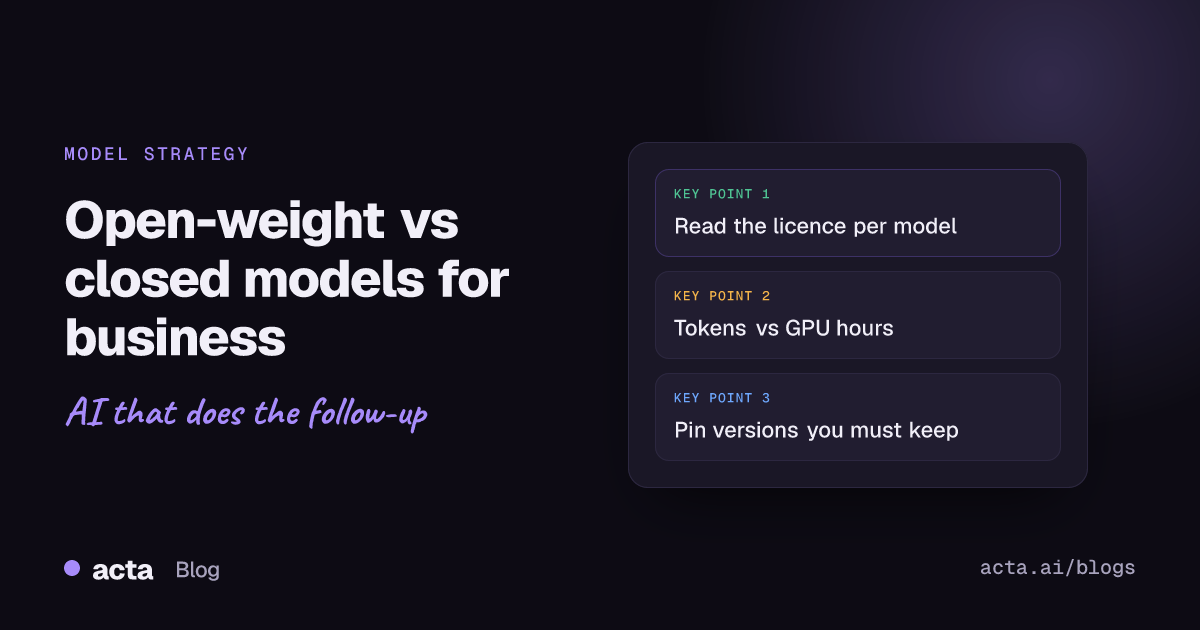
Open-weight vs closed models is a choice about control. Open-weight models (Llama, Gemma, Qwen, Mistral) give you the trained weights to run wherever you like, under a licence you must read. Closed models (GPT, Claude, Gemini) stay on the vendor's servers; you rent access through an API under their terms. Closed usually wins on top-end capability and zero operations. Open weights win when you need data to stay in your environment, a model version that never changes, or deep customisation.
This guide is for CTOs, product leads and procurement teams deciding which models a business can build on. It focuses on what the licences and contracts actually say, as of November 2026, and where each option's real costs sit. If your question is mainly about hosting and hardware, our earlier post on open source LLM vs API for business covers run, rent or buy in more depth. This is general information, not legal advice; have counsel read any licence you plan to ship under.
Key takeaways
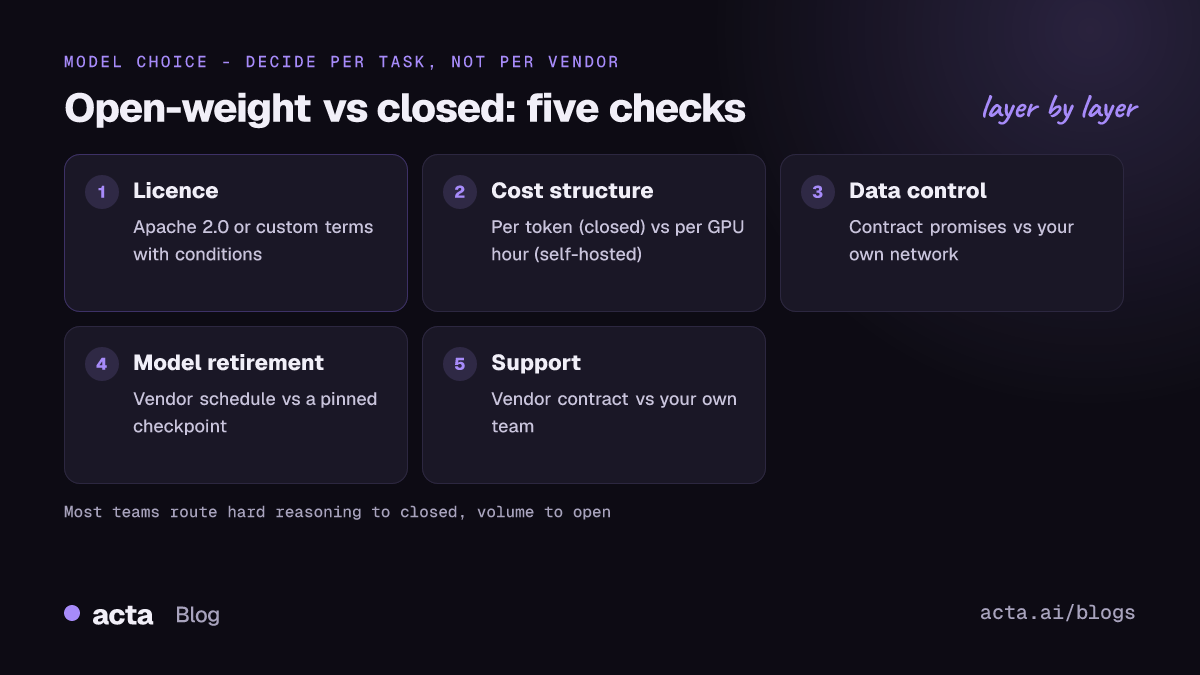
- "Open-weight" means the weights are downloadable, not that the model is open source. Licences range from plain Apache 2.0 (Gemma 4, Qwen3, many Mistral models) to custom terms with conditions (Llama 4).
- Closed APIs charge per token and need no infrastructure. Open weights charge you per GPU hour whether the GPU is busy or idle, so utilisation decides which is cheaper.
- Closed vendors can retire a model on their schedule. An open-weight file you keep will behave the same in five years, which matters for regulated or heavily tested workflows.
- Privacy is not automatic either way: closed APIs offer contract promises, self-hosting gives you physical control plus the security work that comes with it.
- Most teams end up hybrid: a closed frontier model for hard reasoning, an open-weight model for high-volume or sensitive steps.
Table of contents
- Open-weight is not the same as open source
- Open-weight licences differ more than the label suggests
- Closed models bill per token, open weights bill per GPU hour
- Privacy and control depend on contracts or on your own servers
- Closed models retire on the vendor's schedule
- Support and accountability sit in different places
- Open-weight vs closed models: when each one wins
- Most businesses run both behind one gateway
- Where Acta fits
- Frequently asked questions
- Choose your model strategy
Open-weight is not the same as open source
An open-weight model is a model whose trained parameters (the weights) you can download and run yourself. A closed model is one you can only reach through the vendor's API or app; the weights never leave their servers. Most models marketed as "open source" are really open-weight: you get the weights and some code, but not the training data or the full recipe.
The Open Source Initiative's Open Source AI Definition 1.0 sets a higher bar. To count as open source AI, a system has to ship its weights and code under open terms plus enough information about the training data that a skilled person could build a substantially equivalent system. Very few well-known models meet that. So when someone asks "is Llama open source?", the precise answer is that it's open-weight under a custom licence, and the licence is what you have to read.
Why the distinction matters for a business: open source software licences are well understood by legal teams. Custom model licences are not, and they can carry conditions on scale, use or naming that an engineer downloading a file from Hugging Face won't notice.
Open-weight licences differ more than the label suggests
Here's where the four families most businesses look at stood as of November 2026, from each publisher's own pages. Licences are set per model, not per family, so check the card of the exact checkpoint you deploy.
| Family | Licence (as of Nov 2026) | What to check |
|---|---|---|
| Llama 4 (Meta) | Llama 4 Community License | Separate licence needed above 700M monthly active users |
| Gemma 4 (Google) | Apache 2.0 | Older Gemma versions use the Gemma Terms of Use |
| Qwen3 (Alibaba) | Apache 2.0 | Confirm on each model card; terms are set per release |
| Mistral | Apache 2.0 for many open models | Some use the Mistral Research License or MNPL |
Llama. The Llama 4 Community License allows commercial use, but if your products had more than 700 million monthly active users in the preceding calendar month, you must request a licence from Meta, which it can grant at its discretion. Few companies hit that number; the point is that the terms are Meta's, not a standard open source licence, so Llama license commercial use questions go to your lawyer with the actual text.
Gemma. Google released Gemma 4 under Apache 2.0, the first Gemma generation under an OSI-approved licence. Earlier Gemma models remain under the Gemma Terms of Use, which require, among other things, a notice file referencing those terms when you redistribute. If you fine-tuned Gemma 2 or 3, expect your derivative to follow the older terms. That Gemma 4 Apache 2.0 switch is the biggest licensing change of the year for teams that build on Google's open models.
Qwen. The Qwen3 technical report states that all Qwen3 models are available under Apache 2.0, and the Hugging Face cards list apache-2.0. Alibaba ships many Qwen variants, and reporting on later releases describes different terms for some of them, so read the card for the exact model rather than assuming the family licence.
Mistral. Mistral's model weights page lists many open models (Mistral 7B, the Mixtral models, Mistral Small, Magistral Small, Devstral Small) under Apache 2.0, while some others have shipped under the Mistral Research License, which doesn't allow commercial use without a separate agreement, or the Mistral AI Non-Production License (Codestral). Same vendor, three very different answers.
Closed models bill per token, open weights bill per GPU hour
The cost structures are different in kind, which is why "open is cheaper" is only sometimes true.
A closed API is pure variable cost: you pay per input and output token, with no hardware, no idle time and no ops team. Spend tracks usage exactly. The risk is that it scales linearly; a feature that goes from a pilot to every customer multiplies the bill, and you have no control over price changes.
Self-hosted open weights are mostly fixed cost: GPUs (bought or rented by the hour), the engineers who run the serving stack, monitoring and upgrades. Once the GPUs exist, each extra request is close to free, until you need more GPUs. So the question is utilisation. A model serving a steady, high-volume internal workload around the clock can work out cheaper than an API. A model answering a few hundred questions a day sits idle most of the time and almost never does.
Some quick arithmetic helps size the hardware (an estimate, not a benchmark): weight memory is roughly parameters times bits per weight divided by 8. A 31B-parameter model at 8-bit needs about 31 GB just for weights; at 4-bit, about 15.5 GB. Context and concurrent users add memory on top. Our explainer on LLM model size walks through what those parameter counts mean in practice.
There's a middle path: open-weight models served by an inference provider or your cloud's model catalogue. You pay per token like a closed API but keep the option to move the same weights in-house later. That portability is often worth more than the per-token price difference.
Privacy and control depend on contracts or on your own servers
With a closed model, your data protection is contractual. OpenAI's business data page, for example, says that by default it does not use data from its API platform or business ChatGPT tiers to train its models, that qualifying organisations can configure retention including zero data retention on the API, and that customers can sign a data processing addendum. Other vendors publish similar commitments. Read the specific terms for your plan; consumer tiers often differ from business ones.
With self-hosted open weights, the control is physical. Prompts never leave your network, which can settle questions from security teams and customers that a contract can't. The flip side: you own every part of the security work. Access control, logging, patching the serving stack, and vetting the weights you download all become your job. Our post on AI supply chain security covers what to check before you load a model file from the internet.
Don't assume an open-weight model is private just because it's open. If you call it through a third-party host, that host's data terms apply, exactly as with a closed vendor. And if you want to run one locally to try it, Ollama, LM Studio, llama.cpp and vLLM are the usual starting points.
Closed models retire on the vendor's schedule
Closed vendors improve their models constantly, and they retire old ones. OpenAI keeps a public deprecations page listing models and endpoints with shutdown dates and recommended replacements; check whether your vendor publishes an equivalent list. When a model you built prompts and evaluations around is retired, you re-test and sometimes rewrite.
For most chat and drafting features that's an acceptable cost; newer models are usually better. It's a real problem for workflows where behaviour must stay fixed: a classifier whose outputs feed an audit, an extraction step validated against hundreds of documents, a regulated process where any model change triggers re-approval.
An open-weight model is a file. Pin the exact checkpoint and its hash, and it will produce the same distribution of outputs next year as today, on hardware you control. You can also fine-tune it with any tooling you like, while closed models can be customised only as far as the vendor's own fine-tuning options allow. That combination of a frozen version and full customisation is the strongest argument for open weights in many businesses, stronger than price.
Support and accountability sit in different places
A closed vendor is a single accountable party: enterprise contracts, support channels, status pages, and someone to escalate to when the API misbehaves. Ask what their contract covers on uptime, data handling and liability for outputs, and whether those terms differ between plans.
With open weights, the publisher owes you nothing beyond the licence. Support comes from your own team, from the community, or from whichever cloud or inference provider hosts the model for you under their own agreement. That's fine for a team with ML engineers. It's a real gap for a business without one, and it's the most common reason a promising self-hosting pilot stalls after launch.
Be honest about this in the decision. "We'll run it ourselves" means somebody is on call for it.
Open-weight vs closed models: when each one wins
| Your situation | Lean towards |
|---|---|
| Need the strongest reasoning, small volume | Closed API |
| No ML engineers, want zero operations | Closed API |
| Data must not leave your network | Self-hosted open weights |
| Steady high volume on a narrow task | Open weights, possibly fine-tuned |
| Output must stay identical for audits | Pinned open-weight checkpoint |
| Want flexibility, unsure of volume | Open weights via a hosted provider |
Pick closed if you're early, small, or need the best model for a hard problem and can live with vendor terms. Pick open weights if control is the requirement rather than a nice-to-have: data locality, a frozen version, or customisation the vendors won't offer. For open weight models for business use, start with an Apache 2.0 model where you can, simply because your legal review gets shorter.
Most businesses run both behind one gateway
The setup that ages best puts a thin routing layer between your applications and the models. Each task is sent to the model that suits it: a closed frontier model for complex reasoning and customer-facing drafting, a smaller open-weight model for classification, extraction, redaction or anything touching sensitive data. The applications never hard-code a vendor.

Make the switch cheap. Keep prompts and evaluation sets in version control, run the same evaluation set against any candidate model before switching, and log which model answered each request. When a closed model is retired or a better open release lands, you change a routing rule and rerun the tests rather than rewriting the feature. The debate about open source vs closed source LLM choices then becomes a per-task decision you can revisit every quarter, not a bet on one vendor.
Where Acta fits
Meeting transcripts are one of the most sensitive inputs a company feeds to models. Acta does not use customer data to train AI models, and its MCP connector lets you bring your meeting notes into Claude or ChatGPT when you choose to. If you prefer no bot in the call, the desktop app captures meetings from your own computer.
Frequently asked questions
What is the difference between open-weight and open source AI?
Open-weight AI means the trained weights are downloadable, usually under a licence with conditions. Open source AI, under the Open Source Initiative's definition, also requires open terms for code and weights plus detailed information about the training data. Most popular models, including Llama, are open-weight rather than open source by that definition.
Is Llama open source?
Llama is open-weight, not open source in the OSI sense. As of November 2026, Llama 4 ships under Meta's Llama 4 Community License, which allows commercial use but requires a separate licence from Meta if your products exceeded 700 million monthly active users in the preceding calendar month. Read the licence text for the exact version you deploy.
Can I use Gemma 4 commercially?
Yes. Google released Gemma 4 under the Apache 2.0 licence in 2026, which allows commercial use with the usual Apache conditions such as keeping licence and notice files. Earlier Gemma versions stay under the separate Gemma Terms of Use, so a product fine-tuned from Gemma 2 or 3 follows those terms instead.
Are open-weight models more private than closed APIs?
Only when you run them on infrastructure you control, so prompts never leave your network. Called through a third-party host, an open-weight model is subject to that host's data terms, just like a closed API. Closed vendors such as OpenAI state they don't train on API data by default, but that protection is contractual.
Is Qwen free for commercial use?
The Qwen3 models are released under Apache 2.0 according to Alibaba's Qwen3 technical report, which allows commercial use. Alibaba publishes many Qwen variants and sets terms per release, so check the licence on the Hugging Face card of the exact checkpoint before you build a product on it.
Choose your model strategy
Decide per task, write the decision down, and make switching cheap.
- Read the licence: write down the exact checkpoint, its licence and any scale or use conditions before engineering starts.
- Price the utilisation: estimate monthly volume honestly; idle GPUs make self-hosting expensive.
- Classify the data: mark which tasks touch data that must stay in your network.
- Plan for retirement: keep an evaluation set so a forced model change takes days, not months.
- Name an owner: someone must be on call for any model you host yourself.
If your meetings are where the sensitive context lives, try the Acta Chrome extension for Meet, Teams and Zoom in the browser, free for 15 days.