Business 8 min read
Acta.ai vs Otter.ai: A Comprehensive Comparison and Why Acta.ai Is the Future of AI Meeting Intelligence
In today’s digital workplace, meetings are central to collaboration, decision-making, and execution. However, capturing the insights, action items, and decisions from these conversations remains a persistent challenge. Manually taking notes during meetings not only distracts from participation but also leads to inconsistent documentation and lost context. In response, AI-powered meeting intelligence platforms have emerged as indispensable tools, capable of transcribing conversations, summarizing discussions, and extracting key information.
Among these platforms, Acta and Otter are two prominent solutions — each with its strengths and appeal. Otter has become widely known for its reliable transcription, searchable transcripts, and collaboration features. Acta, on the other hand, positions itself as a next-generation meeting intelligence and execution platform that goes beyond transcription to generate structured, actionable outputs aligned with business workflows.
This article provides a detailed comparison between Acta and Otter, examines their capabilities, and explains why many organizations should consider choosing Acta for long-term value and business impact.
1. Understanding the Market: Why AI Meeting Intelligence Matters
Modern teams are distributed. Meetings happen across time zones, platforms, and formats — text chats, audio calls, video conferences, and hybrid work sessions. In this environment, the volume of information produced is enormous. Without tools to capture and surface insights, teams face:
Missed action items
Unclear decisions
Repeated discussions
Knowledge silos
Difficulty onboarding or revisiting discussions
Traditional meeting tools focus on video and audio delivery, leaving organizations to bridge the intelligence gap manually. AI meeting intelligence platforms aim to fill this gap by:
Recording and transcribing conversations in real time
Identifying key topics, decisions, and action items
Summarizing and distributing insights
Integrating with collaboration and workflow tools
In 2026, this category is no longer a luxury but a requirement for productivity optimization.
2. Overview of Otter
Otter was established early in the AI meeting space and quickly gained traction for its transcription accuracy and ease of use. Its core competency is converting spoken language into text with live captions, making meetings more accessible and searchable.
Key Features of Otter
Real-Time Transcription and Live Captions
Otter provides real-time speech-to-text during meetings, supporting multiple languages and accommodating various accents and speaking patterns.Searchable Meeting Transcripts
Users can search across transcripts for keywords, phrases, and topics. This capability is critical for teams that need to retrieve information quickly.Automated Summaries
Otter generates summary highlights and extracts key points from transcripts. While useful for quick review, these summaries are general and not always structured for business workflows.Collaboration and Sharing
Teams can share transcripts, add comments, and collaborate within the Otter system.Integrations with Video Conferencing Platforms
Otter integrates with major platforms like Zoom, Microsoft Teams, and Google Meet. It can join meetings automatically and capture transcripts without manual start/stop.Mobile and Web Access
Otter offers apps on both mobile and web, allowing users to access transcripts and recordings on the go.Otter Meeting Agents
More recent enhancements include AI-assisted meeting agents that provide contextual insights and assist with meeting intelligence beyond simple transcription.
Strengths of Otter
Ease of Use: Intuitive interface that non-technical users can adopt quickly.
Transcription Reliability: Market-leading speech-to-text capability with high accuracy.
Search and Recall: Powerful keyword search across meetings.
Collaboration: Built-in capabilities for teams to comment and annotate.
Limitations of Otter
Limited Actionability: While Otter captures information well, it does not automatically convert conversations into executable tasks or structured business outputs.
Generic Summaries: Summaries provide high-level context but are not tailored to specific business use cases.
Standalone Outputs: Insights remain within the Otter platform unless manually exported or integrated through third-party connectors.
3. Introduction to Acta
Acta represents a broader and more advanced evolution in the world of AI meeting intelligence. It goes beyond transcription to provide context-aware, role-specific intelligence that connects meetings to business workflows.
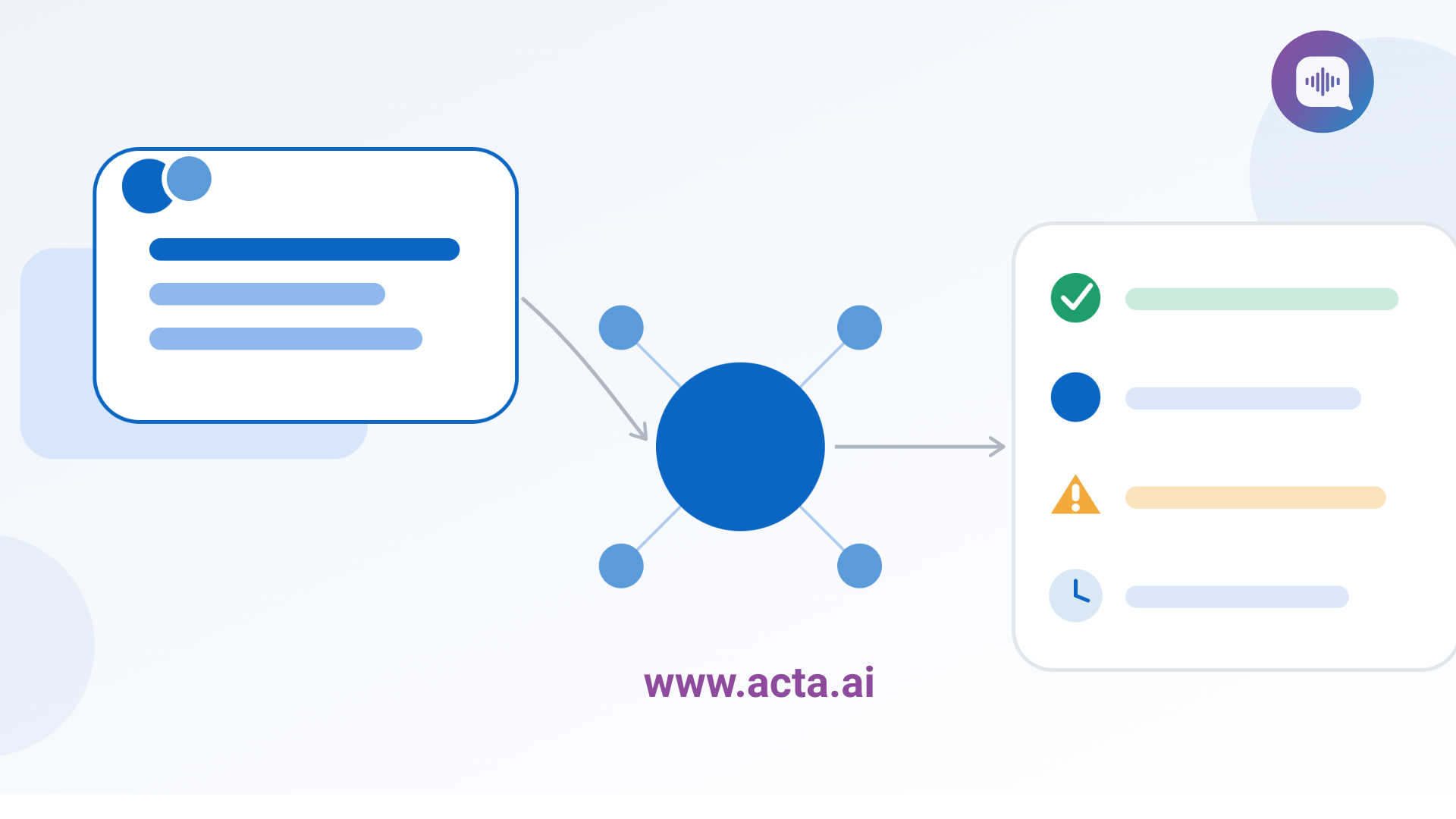
At its core, Acta combines next-generation transcription with intelligent agents capable of converting spoken content into structured documents, actionable outputs, and tasks that directly feed into an organization’s work management systems.
Key Features of Acta
Real-Time Transcription with Contextual Awareness
Like Otter, Acta transcribes conversations in real time. However, it also understands context such as speaker roles, project relevance, and business objectives.AI-Driven Agents
Acta deploys specialized AI agents tailored to functions such as sales, engineering, HR, product management, and customer support. These agents interpret conversation content and produce business-ready outputs.Structured Outputs and Deliverables
Rather than summaries alone, Acta can generate structured artifacts such as:Project requirement documents
Jira tickets or task assignments
Sales call summaries with next steps
Candidate evaluation reports
Customer issue escalation summaries
Multi-Meeting Consolidation
Acta can aggregate information across multiple meetings to produce consolidated insights. Rather than isolating each meeting, it synthesizes longitudinal knowledge.Workflow Integrations and Execution
Acta connects directly with tools like Jira, Salesforce, Notion, Confluence, and other enterprise systems — not just for export, but for execution.Enterprise-Grade Security
With zero-trust principles, data sovereignty options, and compliance certifications, Acta is designed for large organizations and regulated industries.
Strengths of Acta
Actionable Intelligence: Converts conversational data into structured, business-ready outputs.
Agent-Driven Interpretation: Delivers outputs tailored to function and role.
Longitudinal Knowledge: Synthesizes across multiple meetings or projects.
Integration with Operational Workflows: Feeds directly into task and project systems rather than leaving outputs in a silo.
Ideal Use Cases for Acta
Sales teams needing structured call summaries and pipeline insights
Product teams generating PRDs from roadmap meetings
Engineering teams creating tickets from sprint discussions
HR teams synthesizing interview outcomes
Customer support and account teams documenting customer issues
4. Transcription and Contextual Understanding
Otter is well-known for transcription accuracy and live captions. Its AI models are trained on diverse speech patterns, making it reliable for meetings, lectures, and interviews.
However, transcription alone is not enough for business execution. Transcripts capture what was said, but they don’t inherently infer meaning, context, or next steps.
Acta retains transcription accuracy but layers an additional dimension: contextual awareness. This means Acta:
Distinguishes roles (e.g., who is a hiring manager vs. interviewer)
Associates segments of conversation with business objectives (e.g., project deliverables, sales outcomes)
Infers intent and converts insights into structured entities
This contextual intelligence is the foundation for generating outputs that are immediately usable.
5. Actionable Intelligence vs Passive Capture
One of the most significant differentiators is the actionability of outputs.
Why Transcription Alone Is Not Enough
Consider a typical team meeting. Participants discuss:
Action items
Deadlines
Risks
Dependencies
Decisions
Even a complete, accurate transcript does not automatically:
Assign owners to tasks
Create tickets in workflow systems
Flag risks for leadership
Summarize decisions in business terms
This is where Acta’s design philosophy fundamentally diverges from transcription-centric tools.
Acta’s Approach to Actionability
Acta uses intelligent agents that not only detect key items but also perform the following:
Generate structured outputs such as task lists with owners and due dates
Populate operational systems (e.g., Jira tickets, CRM stages) directly
Synthesize decisions into business documents
Extract role-specific insights (e.g., hiring scorecards, sprint requirements)
This approach transforms meetings from static text into dynamic, executable work streams.
6. Role-Based Intelligence
Not all meetings serve the same purpose. A sales call differs fundamentally from a sprint planning meeting or a hiring interview. Acta understands this and uses role-aware agents to interpret meaning.
Examples of Role-Based Intelligence
Sales Calls
Extract: customer needs, objections, next steps
Output: structured sales summary, CRM entry
Project Planning & Engineering
Extract: tasks, dependencies, deliverables
Output: Jira tickets, backlog items
HR & Recruiting
Extract: candidate evaluations, skill gaps
Output: structured candidate scorecards
Customer Support
Extract: issues, impact, resolution paths
Output: escalation summaries, service tickets
Otter provides transcripts and topic tags, but it does not inherently tailor outputs to specific business functions.
7. Multi-Meeting Knowledge and Consolidation
Enterprises rarely operate in a vacuum of single isolated meetings. Projects span weeks, months, and quarters. Acta’s ability to consolidate insights across multiple meetings provides:
Longitudinal understanding
Trend identification
Decision trajectories
Cross-meeting consistency
For example, product managers can ask Acta:
“What key decisions were made across all roadmap meetings this quarter?”
Otter, while searchable across transcripts, cannot synthesize multi-session narratives in this way.
8. Workflow Integrations and Business Execution
Both platforms offer integrations with enterprise tools, but the purpose and implementation differ.
Otter Integrations
Zoom, Teams, Google Meet
Calendar apps
Export support to external task tools via connectors
These integrations primarily serve capture and retrieval.
Acta Integrations
Direct connections to Jira, Salesforce, Notion, Confluence
API support for internal systems
Workflow actions that drive execution
Instead of exporting text, Acta injects structured outputs into systems where work actually happens.
9. Enterprise Security and Compliance
Security is crucial, especially for regulated industries (healthcare, finance, legal, government).
Otter Security
Encryption in transit and at rest
Role-based access controls
SOC2 and GDPR compliance
Acta Security
Zero-trust architecture
End-to-end encryption
Data sovereignty options (regional storage)
HIPAA, SOC2, GDPR, and enterprise governance
Dedicated access controls and audit logs
Acta is designed for organizations that require strict data control policies.
10. Real-World Use Case Comparisons
Case 1: Sales Teams
Otter
Records calls
Provides searchable transcripts
Extracts key phrases
Acta
Summarizes sales calls into structured documents
Assigns next steps to owners
Updates CRM with pipeline changes
Outcome: Acta accelerates pipeline velocity and reduces manual follow-up.
Case 2: Product & Engineering
Otter
Captures sprint planning notes
Teams manually parse actions
Acta
Detects tasks, dependencies
Creates Jira tickets automatically
Prioritizes backlog items
Case 3: HR & Recruiting
Otter
Transcribes interview discussions
HR teams manually extract candidate evaluations
Acta
Produces structured candidate scorecards
Notes skill assessments and gaps
Tracks hiring themes across candidates
11. Accessibility and User Experience
Both platforms offer web and mobile access, but their design focus differs:
Otter emphasizes ease of access and user-friendly transcription.
Acta emphasizes structured workflows and business outputs.
12. Pricing and Value Proposition
While specific pricing varies with features, Acta’s value comes from business outcomes, not just transcription. Otter is more transcription-centric.
13. Limitations and Considerations
No system is perfect. Otter’s strength in transcription may be sufficient for some teams. Acta’s advanced features require configuration and alignment with workflows.
14. Conclusion
In 2026’s digital workplace, simply capturing what was said is insufficient. Organizations now demand intelligence that transforms conversations into action, execution, and business impact.
Otter remains a strong player for transcription and searchable insights. However, Acta redefines meeting intelligence by bridging the gap between capture and execution — turning meetings directly into business-ready outputs.
For teams focused on productivity, operational alignment, and measurable outcomes, Acta offers a transformative leap beyond transcription.
Top of Form