Business 3 min read
AI Career Readiness for Middle & Senior Managers
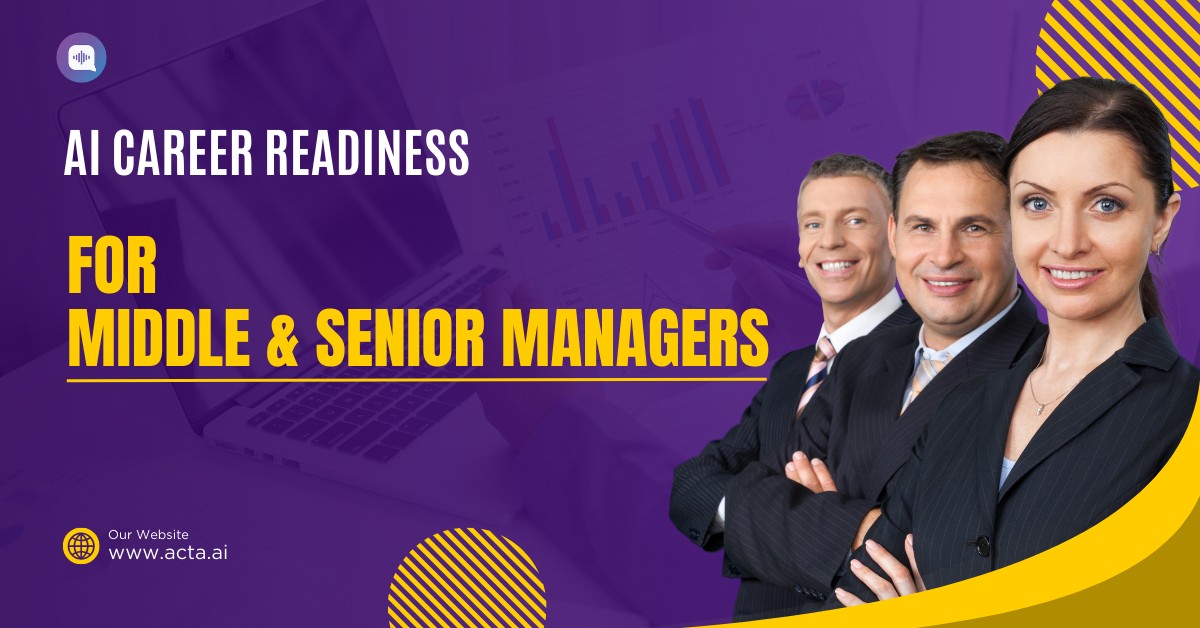
This executive guide explains the critical skills, enterprise governance practices, and AI risk management knowledge required for middle and senior managers to lead AI initiatives successfully.
Powered by Acta.ai.
1. Strategic & Business Skills
AI Strategy & Vision: Understanding where AI creates competitive advantage
· Example – Identifying customer churn and sponsoring an AI-driven churn prediction initiative.
Business Problem Framing: Translating business challenges into AI-solvable problems.
· Example – Converting low sales productivity into an AI conversation intelligence use case.
ROI & Value Measurement: Defining KPIs, cost-benefit analysis, and value realization
· Example – Measuring reduction in manual reporting using Acta.ai meeting summaries.
AI Product Thinking: Lifecycle from idea to scale
· Example – Running pilots before scaling AI across departments.
Change Management: Driving AI adoption across teams.
· Example – Training teams to adopt AI insights confidently.
2. Core AI & Data Literacy
AI/ML Fundamentals: Supervised, unsupervised learning, generative AI basics
· Example – Understanding how generative AI models
Data Understanding: Data quality, bias, labeling, and data pipelines.
· Example – Ensuring meeting transcripts are accurate and unbiased.
Model Lifecycle Awareness: Training, testing, deployment, monitoring.
· Example – Knowing when AI models require retraining.
Limitations of AI: Hallucinations, overfitting, and explainability challenges.
· Example – Reviewing AI-generated summaries before decisions.
3. Technology & Platform Awareness
Cloud & AI Platforms: AWS, Azure, GCP AI services
· Example – Using cloud AI to process enterprise data securely.
Enterprise AI Tools: MLOps, model monitoring, data platforms
· Example – Integrating Acta.ai with Jira or Asana.
System Integration: AI integration with ERP, CRM, HR, and core systems.
· Example – Syncing AI action items with CRM systems.
Security-by-Design: Identity, access, encryption basics
· Example – Role-based access for sensitive meetings.
4. Leadership & Organizational Skills
Cross-Functional Leadership: Working with data scientists, engineers, legal, and business teams.
· Example – Aligning IT, legal, and business teams.
Talent Management: Hiring and upskilling AI talent.
· Example – Upskilling PMs on AI tools.
Decision-Making with AI: Human-in-the-loop governance
· Example – Human-in-the-loop approvals.
Ethical Leadership: : Responsible AI mindset
· Example – Preventing misuse of employee data.
5. AI Governance & Compliance
Responsible AI: Fairness, transparency, accountability
· Example – Ensuring explainability for audits.
Data Governance: Ownership, consent, lineage, and quality standards.
· Example – Defining data ownership.
Regulatory Awareness: GDPR, AI Act, industry-specific regulations.
· Example – GDPR and enterprise compliance.
Model Governance: Approval processes, versioning, audit trails.
· Example – Formal approvals before rollout.
6. Enterprise AI Risks
Data Risks: Bias, poor-quality data, privacy violations.
· Example – Sensitive board data exposure.
Model Risks: Hallucinations, lack of explainability, model drift
· Example – AI hallucinating incorrect insights.
Operational Risks: Over-automation, system failures, scalability issues.
· Example – Over-reliance on automation.
Security Risks: Data leaks, prompt injection, model abuse
· Example – Unauthorized data access.
Reputational Risks: Ethical misuse, loss of customer trust
· Example – Loss of customer trust.
7. Risk Mitigation Best Practices
Human-in-the-Loop: Example – Mandatory review of AI outputs.
Continuous Monitoring: Example – Accuracy tracking over time.
AI Usage Policies: Example – Rules on meeting recordings.
Robust Testing: Example – Leadership pilots before scale.
Governance Committees: Example – Quarterly AI reviews.
8. Career Transition Roadmap
AI Literacy: Example – Learning through tools like Acta.ai.
Pilot Ownership: Example – Leading one AI use case end-to-end.
Outcome Focus: Example – Demonstrating productivity gains.
Regulatory Awareness: Example – Staying updated on AI laws.
AI Leadership Positioning: Example – Being known as an AI transformation leader.
Conclusion: Managers who combine strategy, governance, and responsible AI leadership—supported by platforms like Acta.ai—will drive sustainable enterprise AI transformation.
For enterprise AI consulting, reach out to contact@acta.ai with your use case. We’ll guide you in designing a scalable and secure AI architecture.