Business 2 min read
Wrong AI Integration Can Trigger Innovative Destruction
AI was supposed to accelerate innovation.
Instead, for many companies, it is accelerating irrelevance.
The real risk is not missing AI, but misapplying it — leading to what can be called innovative destruction.
Innovative destruction means bad AI strategy destroys your own advantage
When companies adopt AI without rethinking their product, they don’t evolve — they erode.
Those who wants to become as part of AI Initiative, should be aware of the classic Intercom story.
For years, Intercom was a category-defining company in customer communication. It reimagined support with chat-first experiences, intuitive design, and human-centered interactions. It was not just a product. It was the standard.
Then AI changed the rules.
The rise of generative AI, wasn’t an evolution, but fundamentally reset the entire industry.
Customer expectations shifted almost instantly. Chat became a commodity. Automation became a baseline. Intelligence became the real product.
And this is where many companies, including strong and well-led ones, made a critical mistake. They tried to add AI into existing systems instead of rethinking the system itself.
Many companies made the same early assumption:
“Let’s add AI to what we already have.”
But AI doesn’t behave like a feature. It reshapes workflows, pricing models, team structures, and product value. When layered onto legacy thinking, it creates friction instead of advantage.
Intercom did make strategic missteps during the AI transition.
They initially focused on improving the existing work-flows with AI as feature, while the market had already shifted to an entirely new model. What once made them successful, such as chat experience, UX, and human-led support, quickly lost its edge as automation and outcomes became the new standard. The real mistake wasn’t capability, it was approach: trying to evolve the product when the moment actually demanded a complete reset.
Even Intercom later emphasized that successful teams are not “bolting on AI,” but rebuilding the system so AI is at the core.
Then they
Rebuilt itself as an AI-native company
Launched Fin (AI agent) as the core product
Shifted from tools → outcomes
Today, Intercom’s AI agent handles 80%+ of support queries and resolves ~1M issues every week, scaling to $100M+ ARR from AI alone.
Intercom did not collapse, but it was forced into a rapid reinvention cycle. It had to introduce AI agents, reposition its value, and realign its product strategy.
This was not optimization. It was survival.
This is the reality of innovative destruction.
It does not come from competitors alone.
It comes from holding onto outdated workflows and assumptions in a world that has already evolved.
The companies that win in this era are not AI-enabled. They are AI-native.
If your AI still requires humans to organize outputs, assign tasks, and manually execute next steps, it is not solving the problem. It is accelerating an outdated process.
The future of work is moving toward a different model.
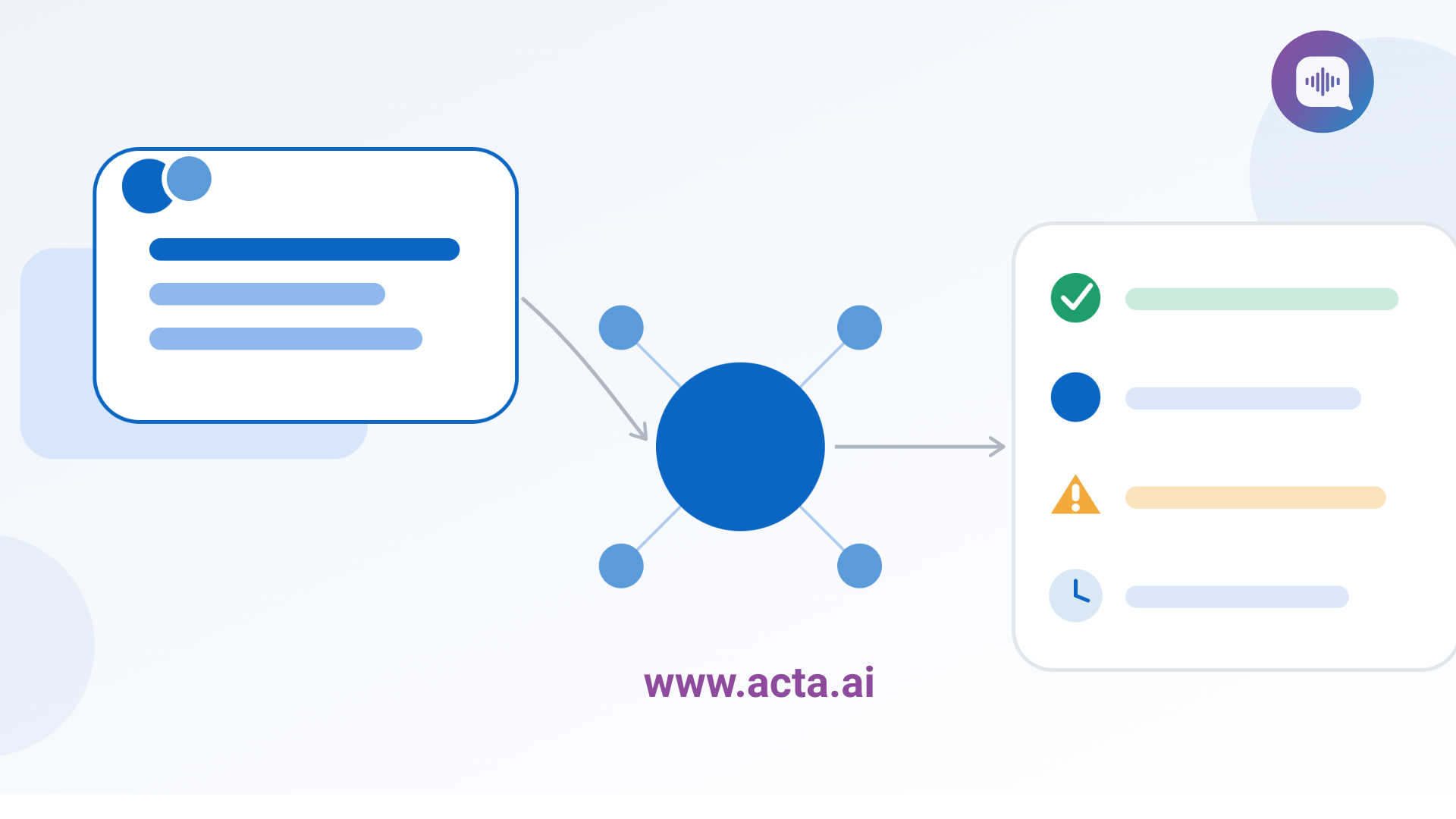
From conversation to execution. Automatically. This is what Acta.ai . Acta helps eliminating post meeting administrative activities.
Most companies are still building copilots. The market is moving toward autopilot.
This is where the next generation of products will be defined.